

Table of Contents
- Leather vs Synthetic Fire Helmet Gear: A Direct Comparison
- NFPA 1971 Helmet Standards: What Both Materials Must Pass
- Durability, Service Life, and PPE Retirement
- Custom Leather Fire Helmet Parts: Brims, Front Holders, and Suspension Systems
- Leather Fire Helmet Maintenance Tips: Decontamination and Care
- Cost, Manufacturing, and the Hidden Price of Gear Ownership
- Conclusion: Which Material Belongs on Your Helmet?
- Frequently Asked Questions
Last Updated: September 13, 2026
Leather vs Synthetic Fire Helmet Gear: A Direct Comparison
Walk into any firehouse and you'll find traditional leather and modern composite helmets hanging side by side. This guide from EH Coverings breaks down leather vs synthetic fire helmet gear, material composition, weight distribution, NFPA 1971 compliance, and long-term care costs, so you can decide which shell belongs on your head.
The trade-off is simple: leather offers unmatched durability and tradition, while composites and thermoplastics prioritize lighter weight and lower upfront cost. Both meet the same structural firefighting standards, but they age, clean, and feel different after a 12-hour shift.
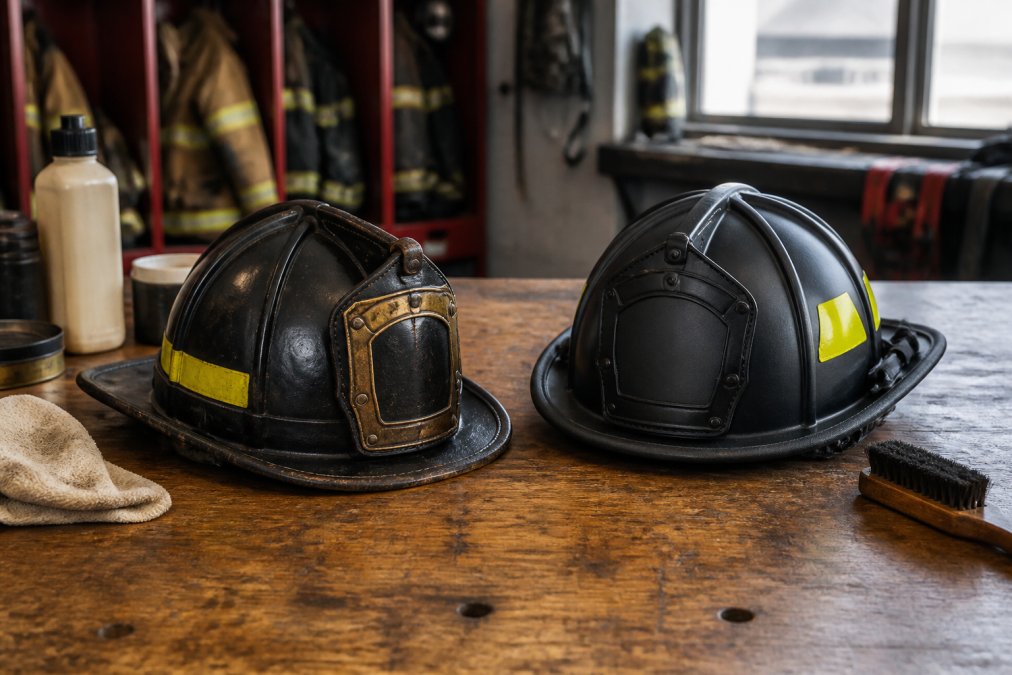
Material Composition: Leather vs Composites vs Thermoplastics
Leather fire helmets are built from thick, vegetable-tanned cowhide shaped, stitched, and reinforced with internal wire. The material develops a patina over years of service and can be reconditioned rather than replaced.
Composite helmets use fiberglass or Kevlar woven into a resin matrix, creating a rigid shell that resists impact and heat without solid leather's weight. Thermoplastic helmets are injection-molded from high-performance polymers, the lightest and cheapest option, but the least durable over a full career.
| Material | Weight | Heat Resistance | Lifespan | Repairability |
|---|---|---|---|---|
| Leather | Heavy | High, with natural char resistance | Decades | Fully repairable |
| Composite | Moderate | High, resin-dependent | 5-10 years | Limited |
| Thermoplastic | Light | Moderate, can deform | 3-5 years | Not repairable |
Weight, Ergonomics, and Cervical Strain
Weight distribution matters more than total ounces. A leather helmet often weighs more on paper, but its mass sits low and close to the skull, reducing the pull on neck muscles during extended incidents.
Composite and thermoplastic shells shift weight higher because of their molded crowns and integrated suspension systems. Over a 24-hour shift, that shows up as cervical strain, especially for firefighters looking up at ceilings or down at patients.
A common mistake is choosing the lightest helmet without testing it under load. Add a visor, flashlight bracket, and communications earpiece, and a "light" thermoplastic can end up heavier than a well-balanced leather shell.
NFPA 1971 Helmet Standards: What Both Materials Must Pass
Every structural firefighting helmet sold in the U.S. must meet NFPA 1971 Standard on Protective Ensembles for Structural Fire Fighting, regardless of whether the shell is leather, composite, or thermoplastic. The standard covers impact resistance, heat deflection, flame resistance, and retention system performance under the same test conditions.
What changes is how they pass, not whether. Leather relies on natural thickness and char-forming behavior; composites on resin chemistry and fiber layup; thermoplastics on additives and shell geometry.
Heat Resistance, Impact Resistance, and Arc Flash Protection
Heat deflection testing measures how a shell behaves under radiant and conductive heat. Leather chars slowly and insulates well. Composites resist until the resin reaches its glass transition temperature, then soften. Thermoplastics deform earliest.
Impact resistance is where modern composites shine: their layered construction spreads force across a wider area when a tool or debris strikes the crown. Leather absorbs impact through density, and a well-maintained shell handles repeated strikes without cracking.
Arc flash protection is a separate concern. Rated helmets use non-conductive shells and hardware. Leather is inherently non-conductive when dry, but wet leather and exposed rivets compromise that; composite and thermoplastic shells with proper hardware avoid the issue entirely.
Durability, Service Life, and PPE Retirement
Leather helmets routinely outlast their owners' careers. A properly maintained leather shell can serve 20 years or more, which is why so many firefighters pass them down or restore them.
Composite shells typically retire after 5 to 10 years, depending on exposure. Thermoplastic shells often retire in 3 to 5 years. NFPA 1851 Standard on Selection, Care, and Maintenance of Protective Ensembles sets the framework for inspection and retirement, and it applies equally to all shell materials.
Shell Integrity, Porosity, and Structural Breakdown
Leather's porosity is both strength and weakness. It breathes, aiding heat management, but also absorbs contaminants. Once saturated with soot and chemical residue, it can't be fully cleaned without damaging the leather.
Composite and thermoplastic shells are non-porous, so they don't absorb contaminants the same way. Decontamination is easier, but the shell can hide surface damage that would be visible on leather.
What most guides miss: shell integrity is about more than cracks. Delamination in composites, crazing in thermoplastics, and dry rot in leather all signal the end of service life, even when the helmet looks fine from a distance.
Custom Leather Fire Helmet Parts: Brims, Front Holders, and Suspension Systems
Custom leather fire helmet parts let you rebuild or upgrade a helmet without replacing the shell. At EH Coverings, we machine and hand-finish components for MSA, E.H. Coverings, Cairns, and Morning Pride helmets, so you're not locked into one manufacturer's ecosystem.
The Natural Leather Brim is cut from American leather, reinforced with a sewn-in shaping wire, and finished with scroll work recreating the classic look of decades past. On a tighter budget, Blemished Leather Brims offer the same construction at a lower price, with cosmetic defects like a missed stitch or off-center art.


Front holders are the other common upgrade. The Carved Front Holders for Service fit Paul Conway American Heritage helmets, while the Black All American Brass fits MSA and E.H. Coverings leather helmets plus the TL2. Each ships with rivets and mounting hardware.
Leather Fire Helmet Maintenance Tips: Decontamination and Care
Leather fire helmet maintenance tips start with one rule: clean after every working fire. Soot and chemical residue break down the tanning oils that keep leather supple, and once it dries out, it cracks. But decontamination now matters for a bigger reason: reducing the wearer's cumulative exposure to carcinogens and other contaminants that ride home on gear.
NIOSH research on firefighter cancer risk and PPE contamination has documented that contaminated gear contributes to occupational exposure, and NFPA 1851 Standard on Selection, Care, and Maintenance of Protective Ensembles now treats routine cleaning as a core compliance requirement rather than an optional routine. That reframes the leather-versus-synthetic question: the material that is easier to fully decontaminate has a long-term health advantage that does not show up on a spec sheet.
Why Leather Is Harder to Decontaminate Than Synthetic Shells
Leather is porous. That porosity lets it breathe and manage heat, but it also means the shell absorbs what it contacts. Soot, polycyclic aromatic hydrocarbons (PAHs), and other combustion byproducts penetrate the grain and lodge in the fibrous structure. Surface cleaning removes what's on the surface, not necessarily what has soaked in.
Composite and thermoplastic shells are non-porous. Contaminants sit on the surface and can be wiped, scrubbed, or, within manufacturer limits, washed more aggressively. That is the single strongest argument for synthetic shells in a health-and-safety procurement conversation.
The trade-off: non-porous shells can hide surface damage. A leather shell shows its history; a composite can look clean while delaminating underneath, and a thermoplastic can look intact while crazing at stress points. Decontamination ease and damage visibility pull in opposite directions.
Cleaning Protocols for Leather vs Synthetic Shells
- Leather: pH-neutral cleaner, soft brush, hand-dry at room temperature, conditioner after every cleaning. Never soak, never machine-wash, never use solvent-based cleaners, they strip the tanning oils and accelerate cracking.
- Composite: mild detergent, soft brush, air-dry away from direct heat, inspect for delamination at the crown and around hardware holes.
- Thermoplastic: mild detergent, soft brush, air-dry, inspect for crazing and deformation, especially around the suspension attachment points.
- All materials: remove the suspension, visor, and any electronics before cleaning; inspect hardware for corrosion; log the cleaning date and the contaminant exposure level (routine, working fire, or gross contamination).
Advanced Decontamination: What Works and What Does Not
For heavy soot and chemical exposure, the cleaning method matters as much as the cleaner. Practical points most guides skip:
- Do not use bleach or chlorine-based cleaners on any shell material. They can degrade resins in composites, attack thermoplastic polymer chains, and strip leather's tanning oils.
- Do not use high-pressure washers. They force water past seals, into suspension hardware, and, on leather, deeper into the grain, where it can carry contaminants further in rather than out.
- Do not dry gear in direct sunlight or near a heat source. UV degrades leather and thermoplastic alike, and heat can warp thermoplastic shells and soften composite resins.
- Do use dedicated gear-washing equipment where available. Departments with extractors designed for turnout gear can often run helmet shells through a gentle cycle, but check the manufacturer's instructions first, some composite and thermoplastic shells are approved for it, most leather shells are not.
- Do separate contaminated gear from clean gear during transport. A contaminated helmet in a gear bag with clean gloves re-contaminates the gloves. This is a logistics problem, not a material problem, but it affects the decontamination outcome regardless of shell type.
The Long-Term Health Angle: What Procurement Should Weigh
For departments writing specifications, the decontamination question is now a health question. A leather shell that lasts 20 years but cannot be fully decontaminated carries a cumulative exposure cost that a 5-to-10-year composite shell does not. That does not mean leather is the wrong choice, it means the total cost of ownership calculation should include decontamination labor, cleaning frequency, and the residual contamination that remains after cleaning.
A practical framework:
- High-exposure, high-frequency structural companies may find that non-porous shells reduce cumulative contaminant load enough to justify shorter replacement cycles.
- Low-exposure, tradition-focused companies may find that leather's longevity and repairability outweigh the decontamination burden, provided cleaning protocols are followed strictly.
- Mixed companies can use leather for ceremonial and low-exposure roles and non-porous shells for the interior attack positions where contamination is heaviest.
Cost, Manufacturing, and the Hidden Price of Gear Ownership
The sticker price is only part of the story. A leather helmet costs more upfront but can serve an entire career with periodic reconditioning. A thermoplastic costs less initially but typically needs replacement two or three times over the same period.
Manufacturing method drives much of that difference. Leather shells are handcrafted, cut, shaped, and stitched by skilled workers. Composite shells are laid up in molds, partly automated. Thermoplastic shells are injection molded, the fastest, cheapest method.
The hidden costs sit in maintenance, decontamination, and replacement. Leather needs more frequent conditioning but rarely full replacement. Synthetic shells need less routine care but hit retirement age faster and can't be repaired once degraded.
For firefighters who want a helmet that stays in service for decades, the Samuel Adams Presentation Helmet represents the top of that category, made from 100% American-sourced materials and crafted by firefighters for firefighters. Note that this model is built for presentation use, not structural firefighting.

Conclusion: Which Material Belongs on Your Helmet?
Leather wins on longevity, tradition, and repairability. Composite wins on impact resistance and ease of decontamination. Thermoplastic wins on price and weight, but only if you accept a shorter service life.
The right answer depends on how you use your helmet. For full-time structural firefighting and gear that lasts a career, leather is the stronger investment. If you rotate helmets frequently or work under strict replacement schedules, composite or thermoplastic may fit better.
Frequently Asked Questions
Do firefighters still wear leather helmets?
Yes. Leather helmets remain common in departments that value traditional style, and they are still manufactured to meet current standards. Many career and volunteer firefighters choose leather for its fit, appearance, and the way it molds to the head over time. Modern leather helmets are built with suspension systems and impact resistance that meet the same performance benchmarks as synthetic options, so tradition does not mean sacrificing protection on the fireground.
Are leather fire helmets NFPA 1971 compliant?
Leather helmets can meet NFPA 1971 standards when manufacturers design and test them to the current edition. Compliance covers heat resistance, impact resistance, penetration protection, and chin strap performance. Not every leather helmet on the market is certified, so check the manufacturer's documentation before buying. A helmet labeled as compliant has passed the same thermal and structural tests as a synthetic model, which matters for PPE compliance and department inspections.
How does maintenance differ between leather and composite fire helmets?
Leather requires more frequent conditioning to prevent drying and cracking, plus careful drying away from direct heat. Composite and thermoplastic shells tolerate moisture better but can develop stress cracks or UV damage over years of exposure. Both need decontamination after fire exposure to remove soot and chemical residue. Leather fire helmet maintenance tips often include using a dedicated leather conditioner, while synthetic shells typically need mild soap and water with a soft brush.
Which fire helmet material offers the best long-term durability?
Leather helmets can last decades with proper care, often outlasting thermoplastic shells that may become brittle or crack after repeated heat exposure. Composite shells resist moisture and chemicals well but have a defined service life and should be retired after significant impact or heat damage. For firefighters who want gear that stays in service for an entire career, leather combined with quality custom leather fire helmet parts like reinforced brims and brass front holders offers strong long-term value.
Choosing the wrong shell material means either paying for durability you won't use or replacing gear years before you should. EH Coverings builds American-made leather helmet parts and accessories designed to fit MSA, E.H. Coverings, Cairns, and Morning Pride helmets, from brass front holders to full leather brims. Every piece is produced by American workers in an American factory and built to last the duration of a career. Browse the catalog and add to cart to start upgrading your helmet today.