

Table of Contents
- What You'll Need Before You Start
- Step 1: Choose Your Custom Leather Fire Helmet Parts
- Step 2: Understand NFPA 1971 Helmet Modification Standards
- Step 3: Complete a Fire Helmet Front Holder Replacement
- Step 4: Personalize Your Helmet Without Compromising Safety
- Common Mistakes to Avoid When You Customize Fire Helmet Gear
- Conclusion
- Frequently Asked Questions
Last Updated: September 16, 2026
What You'll Need Before You Start
When you customize fire helmet gear, start by knowing exactly which parts your helmet will accept, because a front holder that fits a Cairns may not fit an MSA. The safest approach is to identify your shell model first, then buy hardware built for it.
At EH Coverings, we build brass front holders and leather accessories for MSA, E.H. Coverings, Cairns, and Morning Pride helmets, so we see which combinations work and which ones force a firefighter to drill new holes. Gathering the right parts before you touch the helmet prevents most of the damage we hear about.

Here is what to collect before you begin:
- Your helmet's shell model and current front holder style
- Replacement front holder sized for that shell
- Brass rivets or mounting hardware rated for helmet service
- Leather suspension tabs if the originals are worn
- A drill with a bit matched to your rivet size
- A rivet setter, mallet, and a soft cloth for the shell
Step 1: Choose Your Custom Leather Fire Helmet Parts
Custom leather fire helmet parts fall into two groups: the front holder that carries your shield, and the leather and hardware that hold the helmet together. Buy both from the same supplier when you can, because sizing and finish match better.
A front holder is the brass or leather piece that frames your shield and attaches to the front of the shell. Suspension tabs are the leather loops that anchor the inner suspension to the shell. Brass rivets secure both.

For most working firefighters, one upgrade matters more than the rest: a solid brass front holder that survives heat, impact, and years of station life. Carved front holders for service start at $45.00 and let you upgrade an in-service helmet without replacing the whole thing. If you want a heavier piece, customizable all-American brass runs $75.00 and comes in brass, matte black, or gloss black.
Front Holders, Suspension Tabs, and Hardware
Match each part to the job it does. A front holder carries your identity on the helmet. Suspension tabs carry load. Rivets hold everything together, so they are the last place to cut corners.
| Part | Purpose | Typical Cost | What to Check |
|---|---|---|---|
| Front holder | Frames and mounts your shield | $45-$75 | Shell compatibility |
| Suspension tabs | Anchor inner suspension | $20 per set of 4 | Leather condition |
| Brass hardware | Rivets for holder and crown | $6 per set of 5 | Rivet length |
Suspension tabs cost $20.00 for a set of four. Loose brass rivets for the front holder and crown run $6.00 for a set of five. Replace worn tabs while the helmet is apart, since the labor is the same either way.
Step 2: Understand NFPA 1971 Helmet Modification Standards
The NFPA 1971 helmet modification standards govern how structural firefighting helmets must perform, and any change you make has to leave those protective functions intact. The standard covers the helmet as a complete system, so a modification that affects impact protection, retention, or the shell's structural integrity can take the helmet out of compliance.
That does not mean you cannot customize. It means you customize within limits. Cosmetic changes and part replacements that use manufacturer-style mounting points generally stay inside the standard. Cutting, drilling new holes in structural areas, or removing material from the shell generally do not.
The NFPA 1971 standard for structural fire fighting protective ensembles is the document your department's safety officer will reference if a helmet is questioned. The National Institute for Occupational Safety and Health fire fighter safety resources also publishes guidance on helmet inspection and retirement that is worth reading before you modify anything.
Step 3: Complete a Fire Helmet Front Holder Replacement
A fire helmet front holder replacement is the most common customization firefighters ask about, and it is a job most people can finish in under an hour with the right tools. The key is to work on the existing mounting points and avoid creating new ones.
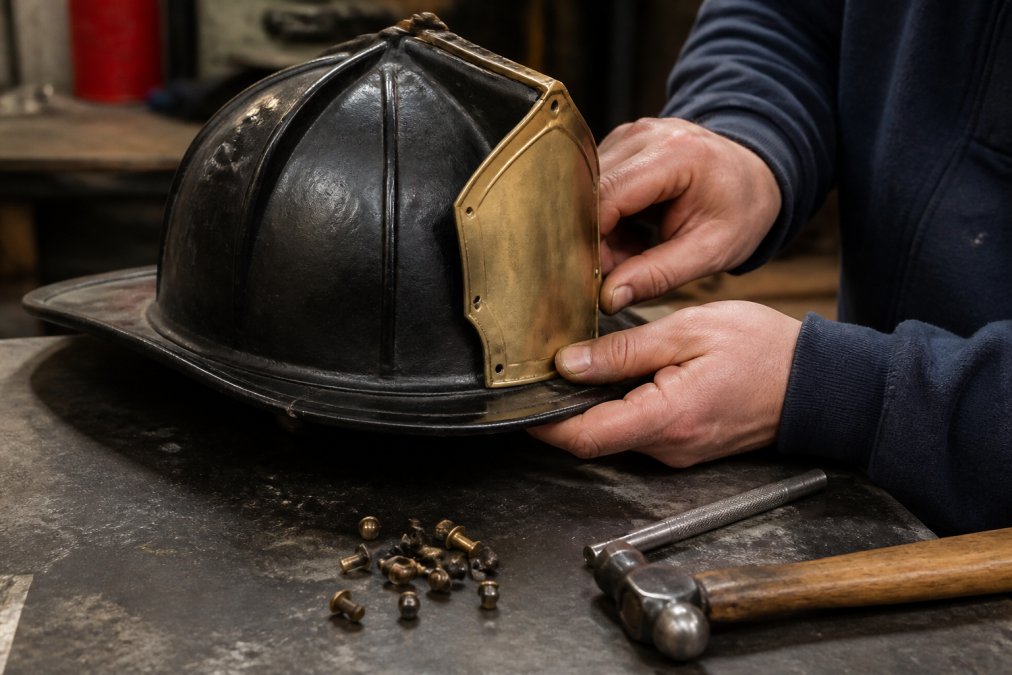
Start by removing the old holder. Drill out the rivet heads carefully, using a bit slightly larger than the rivet shank, and stop the moment the head separates. Prying a stubborn rivet out with a screwdriver is how shells get cracked.
Set the new holder in place and check the alignment of every hole before you fasten anything. If the holes do not line up, you have the wrong holder for that shell, and forcing it will only damage the leather.
Carved Front Holders for Service →
Mounting and Rivet Placement
Rivet placement decides whether the holder sits flat or pulls the leather out of shape. Work from the center outward, and set one rivet at a time rather than trying to align all of them at once.
- Confirm the holder sits flush against the shell with no gap
- Insert the center rivet first and set it lightly
- Check alignment again before setting the outer rivets
- Set each rivet firmly with a rivet setter, not a hammer alone
- Trim or cover any rivet tail that could rub against the suspension
If you are mounting a Liberty carved front holder, note that it only fits the Paul Conway American Heritage. Check that before you order.
Step 4: Personalize Your Helmet Without Compromising Safety
Personalization should add identity without subtracting protection. The rule we use is simple: if the change can come off without leaving a hole or a mark, it is safe ground.
Safe customization includes swapping the front holder, replacing suspension tabs, adding a name or unit marking on the shield, and changing the finish on hardware. Risky customization includes drilling extra holes, trimming the shell, and attaching anything that changes how the helmet fits or absorbs impact.
The Occupational Safety and Health Administration personal protective equipment standards treats protective equipment as something that must remain in serviceable condition, which is the standard to hold yourself to. If a customization would make the helmet harder to inspect or easier to damage, skip it.
Common Mistakes to Avoid When You Customize Fire Helmet Gear
The mistakes that ruin helmets are almost always about force and shortcuts, not about the parts themselves. Firefighters who take their time end up with gear that lasts a career.
The most frequent error is buying a holder without confirming shell compatibility, then drilling to make it work. The second is reusing old rivets because they still look fine, when the metal has already stretched. The third is setting rivets with a hammer instead of a setter, which deforms the head and loosens the hold.
A fourth mistake is replacing a holder but leaving worn suspension tabs in place. The holder is new, the tabs are not, and the helmet still fits badly.
Conclusion
Getting the parts right the first time is the difference between a helmet that serves you for a career and one that needs fixing every few months. EH Coverings makes all-American brass front holders and leather accessories in an American factory, from American materials, designed to fit MSA, E.H. Coverings, Cairns, and Morning Pride helmets. Our customizable all-American brass front holders and carved front holders are built to last the duration of your career, and our suspension tabs and brass hardware keep the rest of the helmet in service alongside them.
Get started with EH Coverings and add to cart the parts that fit your helmet the first time.
Frequently Asked Questions
Are you allowed to customize your fire helmet?
Yes, most departments allow cosmetic and accessory customization as long as the helmet still meets NFPA 1971 performance requirements. Front holders, leather shields, and suspension tabs are common additions. Check your department's SOP first, because some chiefs restrict what can be added. Non-structural changes like swapping a front holder or adding a leather shield rarely raise issues, but anything that alters the shell or impact protection will.
How do you attach a leather front to a fire helmet?
Most leather fronts slide into a brass front holder, which mounts to the helmet with rivets. EH Coverings front holders ship with three rivets and a sticker pack. You drill through the pre-marked holes on the holder, seat each rivet, and peen it flat. Brass hardware sets with five loose rivets are available if you need extras. Take your time aligning the holder before drilling so the front sits level.
Does customizing a fire helmet void the manufacturer's warranty?
It can, depending on what you change. Cosmetic additions like a front holder or leather shield typically do not affect the shell or impact liner, so most warranties stay intact. Drilling new holes in the shell, painting over reflective trim, or removing factory components will usually void coverage. Keep the original parts and document what you changed. If you are unsure, contact the helmet maker before you drill.
What are the NFPA 1971 helmet modification standards?
NFPA 1971 sets the performance requirements for structural firefighting helmets, including impact, penetration, and heat resistance. The standard does not ban customization, but any modification must not reduce the helmet's protective performance. Adding a front holder or leather shield is fine because it does not alter the shell or liner. Removing or cutting into the shell, or covering reflective markings, can push the helmet out of compliance and fail inspection.