

Table of Contents
- Why Custom Fire Helmet Gear Matters for Daily Duty
- Understanding NFPA 1971 Helmet Compliance for Custom Parts
- Key Custom Leather Fire Helmet Parts to Upgrade First
- Fire Helmet Brass Front Holder Installation: A Step-by-Step Guide
- Choosing Your Custom Configuration: From Brass to Leather
- Maintenance and Cleaning Protocols for Custom Gear
- Build Your Career-Ready Helmet Today
- Frequently Asked Questions
Last Updated: September 8, 2026
Your helmet is the most recognizable piece of your identity on the fireground, but the gear that comes standard from the factory rarely reflects the career you've built or the traditions you carry. Custom fire helmet gear for professionals bridges that gap, allowing you to upgrade durability, visibility, and personal style without compromising the safety standards your life depends on. At EH Coverings, we build American-made brass and leather components designed to serve you for an entire career, not just a single season. Below, we'll walk through the parts worth upgrading first, how to stay compliant, and the installation and maintenance steps that keep your gear inspection-ready.
Why Custom Fire Helmet Gear Matters for Daily Duty
Standard-issue helmets are functional, but they are built to a price point and a generic specification. Custom fire helmet gear matters because it addresses the real gaps that show up during daily duty: comfort over a 24-hour shift, secure fit during rapid intervention, and visibility in low-light conditions.
A common mistake is treating customization as purely cosmetic. In practice, upgrading your leather front and adding retro-reflective trim improves how easily your crew identifies you in smoke and darkness. Many departments now encourage personalization because it directly supports firefighter safety and unit accountability. The gear you choose should reduce fatigue, not add to it, which is why weight and balance matter just as much as appearance.
Understanding NFPA 1971 Helmet Compliance for Custom Parts
NFPA 1971 helmet compliance is the benchmark that governs structural firefighting protective ensembles. It is not a single test but a comprehensive set of performance requirements for thermal protection, impact resistance, penetration resistance, chin strap integrity, and visual/retro-reflective markings. Any custom part you add must not compromise the helmet's certified performance in these areas.
The critical rule is that the helmet's structural core, the composite or fiberglass shell, the impact liner, and the retention system (chin strap and ratchet), must remain factory-certified. Custom leather fronts, shields, and brims are considered accessories; they attach externally and do not replace structural elements. However, the way they attach matters. A front holder that is riveted through the shell can, if improperly installed, compromise the shell's integrity. The NFPA standard assumes that accessories are attached using methods that do not alter the shell's structural properties. Drilling new holes, enlarging existing ones, or using screws that penetrate the shell in non-factory locations can create stress points that fail under impact.
Your department's inspection officer will verify that modifications do not block eye protection, loosen the chin strap, or interfere with the helmet's seating. According to NFPA 1971 standard for structural firefighting PPE, any alteration that affects the helmet's protective performance voids its certification. This is a strict liability standard: it does not matter if the helmet still looks functional. If a modification is deemed to affect performance, the helmet is no longer NFPA compliant, and you cannot wear it in a structural fire.
A common pattern is for firefighters to swap out their standard shield for a custom one with a different shape or size. A shield that is too large can obstruct the helmet's brim from seating correctly or interfere with the facepiece seal of your self-contained breathing apparatus (SCBA). Always test the full ensemble, helmet, hood, and facepiece, to ensure no interference.
Another area of confusion is the difference between structural firefighting helmets (NFPA 1971) and proximity or wildland helmets (NFPA 1976 or NFPA 1977). A leather front that is acceptable on a structural helmet may not be rated for the higher radiant heat exposure of proximity firefighting (nfpa.org). If you are assigned to an aircraft rescue and firefighting (ARFF) unit or a rapid intervention team (RIT) that may face extreme conditions, verify that your custom parts are rated for that specific exposure.
Sticking with manufacturers who design parts for specific helmet models, like MSA, Cairns, and Morning Pride, keeps you on the right side of that rule. A generic part that "fits" may not align perfectly, creating uneven stress on the shell or a loose fit that shifts during operations.
For a practical compliance checklist, consider the following before you make any modification:
- Check the label: The NFPA label inside the helmet lists the manufacturer and model (nfpa.org). Only use accessories explicitly designed for that model.
- Inspect the mounting: Ensure any new holes are drilled at factory-marked locations and are no larger than the original hardware. Use rivets, not screws, as screws can back out under vibration.
- Test the fit: After installation, shake the helmet vigorously. Nothing should rattle or shift. The chin strap must still be snug and the ratchet must function fully.
- Verify visibility: Retro-reflective trim must remain unobstructed. If you add a leather front that covers the trim, you must add compliant trim elsewhere on the helmet.
- Document the change: Keep a record of the modification, including the part manufacturer and model. This helps during annual inspections and if you transfer to a new department.
This level of diligence is what separates a helmet that is merely personalized from one that is both personalized and fully compliant.
Key Custom Leather Fire Helmet Parts to Upgrade First
If you are starting your build, focus on the components that deliver the most visible and functional return: the leather front, the shield, and the brim. These custom leather fire helmet parts transform a generic shell into a piece of gear that fits your face and your department's heritage.
The leather front is the centerpiece. It carries your company number, your rank, or a design that represents your station. A handcrafted leather front with scroll work does more than look sharp. The shield sits on that front and is your primary identifier from a distance. A single-color shield with a bold company number is the most legible option for command officers reading your position from across the scene.
Leather Fronts and Shields: Style Meets Function
The leather front is where tradition and personal expression meet. Natural leather brims with reinforced shaping wire recreate the classic look of helmets from decades past while providing a durable edge that stands up to the heat of the fireground.
When selecting a shield, prioritize contrast. A high-contrast shield with a matte or gloss finish ensures your number is readable in poor light. Many firefighters choose a classic design that mirrors their department's legacy, which keeps the helmet looking professional during public events and ceremonial duties while remaining fully functional on the line.
Brims and Comfort Liners: Fit and Longevity
A quality leather brim is reinforced with a shaping wire sewn in by master craftsmen, which keeps its form after years of exposure to high temperatures. This is where longevity is decided: a cheap brim will curl and crack, while a properly constructed one lasts decades.

Fire Helmet Brass Front Holder Installation: A Step-by-Step Guide
Fire helmet brass front holder installation is a straightforward process, but it requires patience and the right hardware to avoid damaging your leather front. Most quality brass front holders, including those from EH Coverings, come with three rivets for mounting.

- Remove the existing front holder and leather front from the helmet shell.
- Align the new brass holder over the leather front, ensuring the mounting holes line up with the existing holes in the shell.
- Insert the rivets from the outside of the brass through the leather and shell.
- From the inside of the helmet, spread the rivet tails using a rivet tool or a flat punch against a solid surface.
- Test the security of the mount by gently tugging on the holder. It should not shift or rotate.
Choosing Your Custom Configuration: From Brass to Leather
The configuration you choose should reflect how you fight fire and how long you intend to keep the helmet. A polished brass front holder offers a traditional profile that develops a distinguished patina over time, while a matte black or gloss black finish gives a modern profile that resists showing wear.
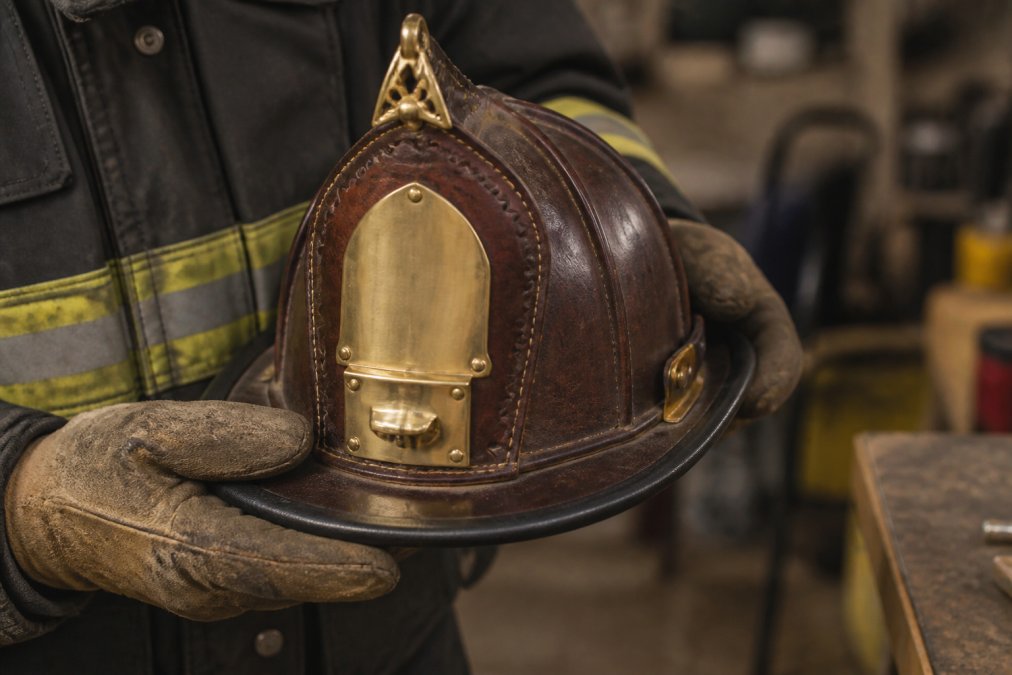
For a budget-conscious upgrade that does not sacrifice quality, carved front holders offer heritage designs like eagles or mythical creatures without the cost of a fully custom piece. For those who want the top tier, a customizable all-American brass holder is reworked and strengthened to stand up to the job while maintaining the appearance you paid for. These holders are designed to fit MSA and E.H. Coverings style leather helmets as well as the TL2.

| Configuration | Material | Starting Price | Best For |
|---|---|---|---|
| Carved Front Holder | Brass | $45.00 | Heritage designs on a budget |
| Customizable All American Brass | Brass, Matte or Gloss Black | $75.00 | A stronger, personalized holder |
| Natural Leather Brim | American Leather | $325.00 | Full traditional rebuild |
| Standard Shield | Leather, Single Color | $45.00 | Maximum legibility for company numbers |
Maintenance and Cleaning Protocols for Custom Gear
Custom gear lasts a career only if you maintain it. Leather and brass require different care routines, and mixing them up will shorten the life of both materials.
For the leather front and brim, wipe down the surface with a damp, lint-free cloth after every overhaul to remove soot and debris. Condition the leather every few months with a product designed for fire service leather; this keeps the material supple and prevents cracking from thermal exposure. For the brass, use a dedicated brass polish to remove oxidation, but avoid getting polish on the leather or the retro-reflective trim. A clear coat can protect the brass finish if you prefer a low-maintenance option.
Build Your Career-Ready Helmet Today
Your helmet is the one piece of gear that stays with you from your first live burn to your last call. Building it with quality custom fire helmet gear ensures it performs every time you need it.
EH Coverings delivers gear made from all-American materials, produced by American workers in an American factory, so you know exactly where your protection comes from. Whether you need a brass front holder that fits your Cairns helmet without modification or a full leather brim to complete a restoration, our components are built to last for the duration of your career.
Get started with EH Coverings and build a helmet that honors your department's heritage while meeting the demands of modern firefighting.
Frequently Asked Questions
Can custom gear affect the safety rating of my fire helmet?
Yes, it can if the parts aren't compliant. Any replacement part, from a leather front to a brass holder, must not compromise the helmet's structural integrity or thermal resistance. EH Coverings parts are designed to fit industry-standard helmets like MSA, Cairns, and Morning Pride without modification. Always verify that your final configuration meets NFPA 1971 standards and your department's SOGs before putting it in service.
How do I know a brass front holder will fit my Cairns helmet without modification?
Our brass front holders are precision-made to fit standard helmet mounting points. For example, the Customizable All American Brass is designed to fit MSA and E.H. Coverings style leather helmets as well as the TL2. Each piece comes with the necessary rivets. If you are unsure about compatibility, contact us with your helmet's model and year before ordering to confirm a proper fit.
What makes American-made leather helmet accessories worth the extra cost?
Durability and accountability. A natural leather brim from EH Coverings is made from high-quality American leather with a reinforced shaping wire sewn in by master craftsmen. It is built to last decades, not seasons. When you buy American-made, you support domestic manufacturing and get a product from a company that stands behind its work, which is what you need for gear that faces high-stakes environments.
What are the NFPA standards for fire helmet modifications?
NFPA 1971 sets the standard for structural firefighting gear, including helmets. It covers impact protection, thermal resistance, and chin strap integrity. Any modification must not reduce the helmet's ability to meet these standards. This means using parts designed for your specific helmet model and avoiding alterations that compromise the shell or impact cap. Always check with your department's safety officer to ensure your custom gear passes inspection.