

Table of Contents
- Why Cleaning Your Leather Fire Helmet Chin Strap Matters
- Tools and Materials You'll Need
- Daily Cleaning and Maintenance for Chin Straps
- Deep Cleaning: Decontaminating Leather Fire Gear After Fires
- Leather Conditioning Techniques for Chin Straps
- How to Restore Old Fire Helmets and Damaged Chin Straps
- Fire Helmet Inspection Checklist: Identifying Wear and Damage
- Frequently Asked Questions
Last Updated: September 29, 2026
Why Cleaning Your Leather Fire Helmet Chin Strap Matters
A clean leather fire helmet chin strap keeps your helmet secure during critical moments, yet many firefighters overlook maintenance until it's too late.
Your chin strap absorbs sweat, soot, and chemical residue that break down leather integrity over time. A compromised strap can slip during critical operations, a safety risk you can't afford.
Regular cleaning and conditioning of your clean leather fire helmet chin strap ensures reliability when it matters most. This guide walks you through every step to keep your strap in peak condition.
Tools and Materials You'll Need
Gather the right supplies to prevent damage and ensure thorough decontamination without compromising fire-retardant properties.
Here's what you need:
- Soft-bristled brush (natural or nylon, not wire)
- Microfiber cloth
- pH-neutral decon solution (acidic or alkaline cleaners break down tanning agents)
- Warm water (100-110°F; hot water opens pores and drives contaminants deeper)
- Leather conditioner formulated for protective gear (avoid silicone-based products)
- Clean towel (lint-free)
- Bucket or basin (non-metal preferred)
Why pH balance matters for fire gear:
Leather chin straps are typically vegetable-tanned or chrome-tanned at pH 4.5-5.5. Cleaners outside this range risk weakening the tanning bond, stripping natural oils, and altering water-resistance.
Look for decontamination soaps labeled "pH-neutral" or "pH-balanced for leather." Many firefighting-specific decon products (such as EH Coverings' All In One Liquid Decon Soap) are formulated to remove carcinogens and volatile organic compounds while maintaining the leather's structural integrity.
Fire-retardant coating considerations:
Daily Cleaning and Maintenance for Chin Straps
Daily maintenance prevents buildup and adds years to your gear's life.
After every shift:
- Wipe down with a damp microfiber cloth to remove sweat, soot, and debris.
- Inspect visually for damage, cracks, or dry areas.
- Air dry completely in a well-ventilated area; avoid direct heat or sunlight.
- Store in a cool, dry place away from heat sources and direct sunlight.
Deep Cleaning: Decontaminating Leather Fire Gear After Fires
After a working fire, your chin strap has absorbed carcinogens, soot, and chemical residue. Deep cleaning removes these hazards.
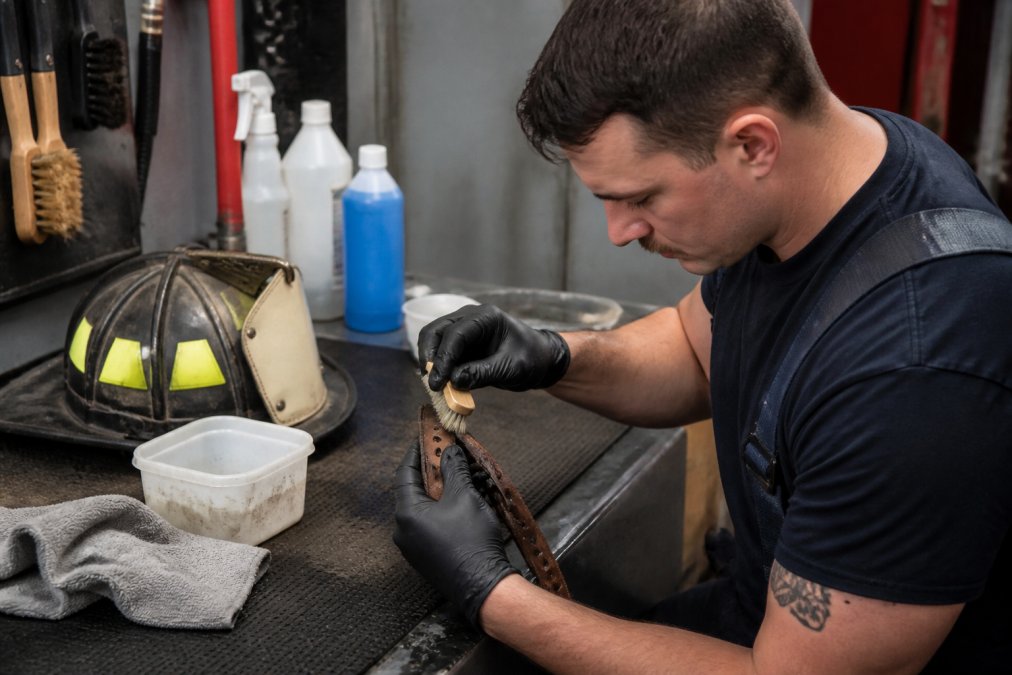
Follow this decontamination protocol:
-
Soak the strap in warm water, Fill a bucket with warm (not hot) water. Submerge the chin strap for 10-15 minutes to loosen embedded contaminants.
-
Apply decon soap, Use a product like EH Coverings' All In One Liquid Decon Soap or another pH-neutral decontamination soap. Our All In One Liquid Decon Soap is scientifically proven to remove all carcinogens, toxins, and volatile organic compounds encountered at a modern structure fire.

All In One Liquid Decon Soap -
Scrub gently with a soft brush, Use light pressure. Work the soap into the leather, paying attention to seams and textured areas where contaminants hide.
-
Rinse thoroughly, Rinse multiple times with clean water until no soap residue remains. Soap left on leather causes stiffness and cracking.
-
Wipe dry with a microfiber cloth, Remove excess water. Pat gently, don't rub hard.
-
Air dry completely, Hang in a ventilated space for at least 24 hours before conditioning. Never use a heat source.
Leather Conditioning Techniques for Chin Straps
After cleaning, conditioning restores elasticity and prevents cracking. The strategy depends on the strap's age and condition.
Assess your leather's condition:
- Supple leather: Light conditioning every 3-6 months
- Slightly stiff leather: Intensive conditioning over 4-6 weeks
- Severely cracked or heat-damaged leather: Replacement is safer than restoration
Proper conditioning process for restorable leather:
-
Wait until leather is completely dry, Conditioning wet or damp leather traps moisture inside. This causes mildew, material degradation, and can accelerate cracking. Allow at least 24 hours of air drying after cleaning before conditioning.
-
Choose a conditioner designed for protective gear, Furniture conditioners and mink oil are too heavy for fire gear. They can leave a sticky residue that attracts dirt and may interfere with moisture-wicking properties. Look for conditioners labeled "for leather protective equipment" or "for work gear." These are formulated to restore elasticity without over-saturating the material.
-
Apply conditioner sparingly, Use a small amount, roughly the size of a dime for an entire chin strap. Work it in with a soft cloth using circular motions. More conditioner does not mean better results; excess conditioner leaves a sticky film that traps sweat and contaminants.
-
Focus on seams and high-stress areas, The chin strap experiences constant flexing at the attachment points and where it fastens under the chin. These areas dry out faster and need extra attention. Work the conditioner into seams gently; don't force it, as aggressive pressure can separate stitching.
-
Wipe away excess, Buff with a clean, dry cloth until the leather feels slightly tacky, not wet. If the strap feels slick or oily after 10 minutes, you've used too much conditioner. Wipe it down again.
-
Let it cure for 24 hours, Don't wear or use the helmet immediately after conditioning. The conditioner needs time to penetrate the leather and set. Store the helmet in a cool, dry place during this period.
Intensive conditioning for stiff leather (4-6 week restoration cycle):
- Week 1-2: Condition every 3 days. Clean the strap lightly with a damp cloth before each conditioning to remove surface dust, then apply conditioner and let cure for 24 hours.
- Week 3-4: Condition every 4-5 days. You should notice the leather becoming more flexible. Flex the strap gently (don't force it) to test progress.
- Week 5-6: Condition weekly. By this point, most stiff leather regains significant elasticity. If the strap still resists bending, stop conditioning and assess whether replacement is necessary.
The goal of conditioning:
How to Restore Old Fire Helmets and Damaged Chin Straps
Older helmets often have chin straps that show serious wear. Cracks, stiffness, and loss of elasticity are common. But many damaged straps can be restored with patience and proper technique.
Assessment first:
- Minor cracks, Surface-level cracks in the leather grain can be treated with conditioning
- Deep cracks, Cracks that go through the leather thickness may require professional repair or replacement
- Severe stiffness, Leather that won't flex needs intensive conditioning over several weeks
- Separation at seams, Stitching that's coming loose indicates structural failure
Restoration process for stiff or cracked leather:
-
Clean thoroughly, Remove all debris and buildup using the deep cleaning method above.
-
Apply conditioner heavily (but not excessively), Use more conditioner than daily maintenance requires. Work it in thoroughly.
-
Condition every 3-4 days, Repeat the conditioning process weekly for 4-6 weeks. Patience is essential.
-
Monitor progress, Check flexibility and appearance after each conditioning cycle.
-
Stop when elasticity returns, Once the leather feels supple and flexes without cracking, return to regular maintenance.
Fire Helmet Inspection Checklist: Identifying Wear and Damage
Regular inspection catches problems before they become safety issues. A simple checklist takes five minutes and could save your life.
Monthly inspection routine:
- Check for visible cracks in the leather
- Flex the strap, it should bend without resistance
- Inspect all seams for separation or loose stitching
- Look for areas where leather appears dried out or chalky
- Test the strap's attachment points to the helmet shell
- Smell for mildew or chemical odors indicating contamination
- Feel the leather's texture, it should be smooth, not rough or brittle
- Check that the chin strap fastens securely without slipping
When to replace your chin strap:
Replace immediately if you notice:
- Deep cracks that go through the leather thickness
- Seams separating or stitching pulling away
- Loss of attachment points where the strap connects to the helmet
- Permanent stiffness that doesn't improve with conditioning
- Mildew growth or persistent odors after cleaning
Frequently Asked Questions
How often should you clean and inspect your helmet chin strap for wear?
Inspect your chin strap daily after every fire for visible damage, cracking, or heat damage to the leather. Clean the strap immediately after working fires using decontaminating soap to remove carcinogens and sweat accumulation. Perform a deeper conditioning and full inspection weekly during active duty cycles. Leather grain and seams are vulnerable areas, check these closely for signs of deterioration or loss of elasticity that could compromise suspension system integrity.
What's the best way to remove sweat and odors from leather fire helmet chin straps?
Use a decontamination soap specifically formulated for fire gear, like our All In One Liquid Decon Soap, which contains activated charcoal to extract toxins and odors. Wet the strap with cool water, apply soap with a soft brush, and work gently into the leather grain and seams. Rinse thoroughly with clean water and air dry completely before storage. The activated charcoal and essential oils eliminate stubborn smoke smell and sweat residue while keeping the leather moisturized.
Can harsh chemicals damage leather fire helmet straps and PPE integrity?
Yes. Harsh chemicals, bleach, and high-pH cleaners can strip protective tanning compounds from leather, causing cracking, loss of elasticity, and structural integrity failure. Use only pH-neutral, sulfate-free decontamination products designed for protective gear. Avoid propylene glycol-based cleaners. Always test any new cleaning agent on an inconspicuous area first. Chemical safety is critical, improper cleaning can compromise the chin strap's ability to secure your helmet during working fire conditions.
What should I do if my leather chin strap is stiff or cracked?
Stiff or cracked leather indicates loss of moisture and elasticity. Soak the affected area with cool water for 10-15 minutes to rehydrate, then apply a quality leather conditioner designed for fire gear. Work the conditioner into the leather grain with a soft brush, focusing on seams and stress points. Air dry completely. Repeat conditioning weekly until elasticity returns. If cracking is severe or the suspension system is compromised, consider restoration or replacement to maintain PPE reliability.