

Table of Contents
- What to Look for in Leather Care Products for Firefighter Gear
- How to Clean Leather Fire Helmet: Step-by-Step Process
- Leather Conditioner for Fire Boots: Conditioning Techniques
- Firefighter Gear Maintenance Standards and Decontamination Protocols
- Waterproofing and Moisture Protection for Heavy-Duty Leather
- Leather Repair vs. Replacement: When to Restore and When to Retire
- Climate-Specific Leather Care for Different Regions
- Recommended Leather Care Products for Firefighter Gear
- Caring for the Gear That Carries You
- Frequently Asked Questions
Last Updated: September 19, 2026
What to Look for in Leather Care Products for Firefighter Gear
Finding the best leather care products for firefighter gear starts with reading the label, not the marketing. The right product cleans without stripping the tanning agents that keep heavy-duty leather supple, and it leaves no residue that could compromise thermal protection. This guide from EH Coverings breaks down ingredients, standards, and techniques so your helmet and boots last a full career.
Leather care is the practice of cleaning, conditioning, and protecting leather goods so the material keeps its strength, flexibility, and protective qualities over time.
Ingredients That Protect vs. Ingredients That Harm
Conditioners built on neatsfoot oil, beeswax, and lanolin replenish hide hydration and keep leather flexibility intact. These natural ingredients penetrate leather pores and support fiber saturation without leaving a greasy film that traps grit.
Ingredients that harm leather fall into a few categories:
- Petroleum-based solvents that strip natural oils and accelerate cracking
- Harsh detergents and sulfates that break down the tanning process
- Synthetic fragrances and dyes that mask smoke smell instead of removing it
- Silicone-based polishes that seal the surface and block conditioning
Chemical Compatibility with NFPA Standards
Any product you put on structural gear has to survive the same conditions the gear does. The National Fire Protection Association publishes standards covering the selection, care, and maintenance of structural fire fighting gear, and the NFPA standards for firefighter protective equipment treat contaminants and cleaning agents as part of the safety picture.
How to Clean Leather Fire Helmet: Step-by-Step Process
Cleaning a leather fire helmet takes about 15 to 20 minutes and requires nothing more than a soft brush, lukewarm water, and a pH-neutral cleaner. The goal is removing soot and smoke residue without soaking the leather or scrubbing the finish off the brim.
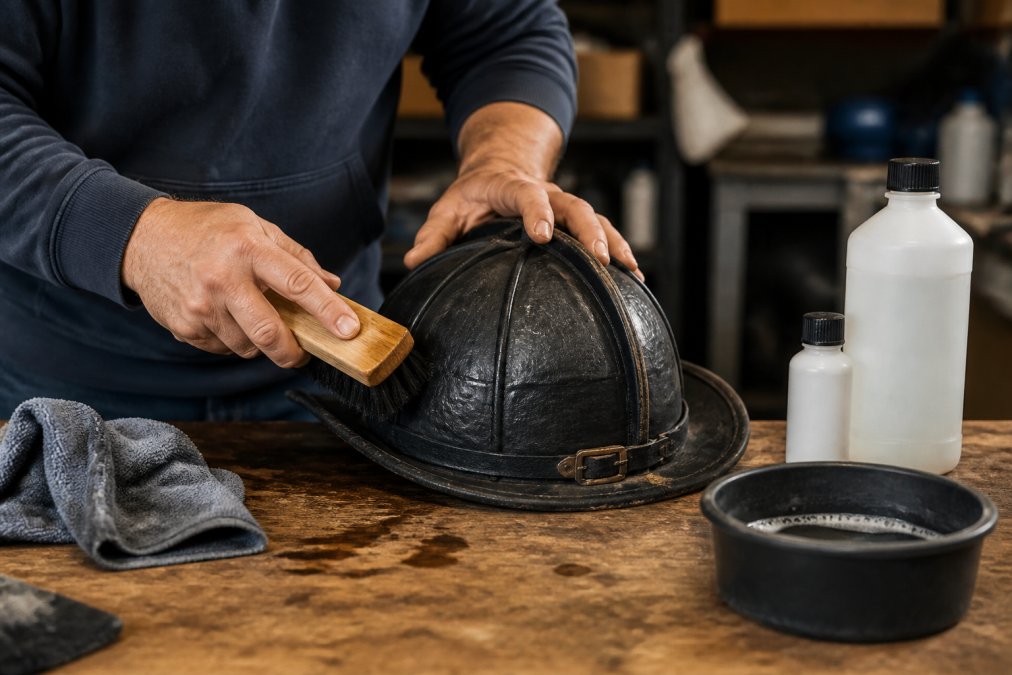
Here's the process that works:
- Brush off loose soot and debris with a dry soft-bristle brush outdoors
- Wipe the shell, brim, and stitching with a damp cloth and mild cleaner
- Work around the brass front holder and any leather accessories carefully
- Rinse the cloth and repeat until it comes away clean
- Dry at room temperature, away from direct heat or sunlight
- Apply a thin coat of conditioner once the leather is fully dry
Removing Soot, Grime, and Smoke Residue
Soot removal is the step most people rush, and it's the one that matters most. Smoke residue from a modern structure fire carries carcinogens and volatile organic compounds that settle into leather pores and stitching. Wiping the surface isn't enough. You need to lift the residue out without pushing it deeper.
Leather Conditioner for Fire Boots: Conditioning Techniques
Conditioning fire boots is different from conditioning a helmet. Boots flex thousands of times per shift, so the leather needs to stay supple at the crease points where cracking starts. A leather conditioner for fire boots should go on in thin layers, worked into the flex zones with your hands.
The technique matters as much as the product:
- Apply a small amount to a clean cloth or your fingertips
- Work it into the toe box, heel counter, and the crease behind the toe
- Let it absorb for 10 to 15 minutes
- Buff off any excess with a dry cloth
- Repeat monthly, or more often in dry climates
Preventing Cracking and Maintaining Flexibility
Cracking prevention comes down to consistency. Leather dries out from heat exposure, sweat, and repeated wet-dry cycles, and once the grain cracks, no conditioner reverses it. Maintaining flexibility means conditioning before the leather feels stiff, not after.
Firefighter Gear Maintenance Standards and Decontamination Protocols
Firefighter gear maintenance standards exist for a reason: contaminated gear puts the wearer and everyone in the station at risk. Decontamination protocols should cover both the gear and the firefighter, and they should run on a schedule, not a memory.
A simple routine:
- Gross decon on scene: brush off visible debris before loading gear
- Full cleaning after every structure fire
- Inspection of leather, stitching, and hardware weekly
- Deep conditioning monthly
- Professional advanced cleaning per department policy
Frequency of Maintenance Based on Usage
Maintenance frequency should track how hard the gear works. A firefighter running multiple structure fires a week needs a different schedule than someone on light duty.
| Usage Level | Clean | Condition | Inspect |
|---|---|---|---|
| Heavy (multiple fires/week) | After every fire | Weekly | Every shift |
| Moderate (1-2 fires/week) | After every fire | Every 2 weeks | Weekly |
| Light (training/rare calls) | After each use | Monthly | Monthly |
Waterproofing and Moisture Protection for Heavy-Duty Leather
Waterproofing protects leather from the moisture that causes rot, mold, and stiffness, but it has to be done right. A water repellent that seals the surface completely will block the leather from breathing and trap moisture inside, which is worse than leaving it untreated.
All In One Liquid Decon Soap →
Leather Repair vs. Replacement: When to Restore and When to Retire
Repair is worth it when the damage is surface-level: scuffed finish, minor cracking, worn stitching, or a loose accessory. Replacement is the answer once the leather itself has lost structural integrity or the gear has been exposed to contaminants that can't be fully removed.
Here's how to decide:
- Surface scuffs and dry patches: condition and restore
- Loose or broken stitching: repair if the leather underneath is sound
- Deep cracks through the grain: replace
- Charred or heat-damaged leather: replace immediately
- Contaminated gear that fails cleaning: retire it
Climate-Specific Leather Care for Different Regions
Climate changes everything about leather care. Humid regions push mold and mildew growth, so gear needs to dry fully before storage and conditioning intervals can stretch slightly. Dry, arid regions pull moisture out of leather fast, and cracking prevention becomes the priority. Cold climates bring a different problem: leather stiffens below freezing, and flexing stiff leather cracks it.
Adjust your routine by climate:
- Humid: Focus on drying and mold prevention; inspect stitching for rot
- Arid: Condition more often; keep gear out of direct sun
- Cold: Warm leather gradually before flexing; condition before winter
- Coastal: Rinse salt exposure; check hardware for corrosion
Recommended Leather Care Products for Firefighter Gear
The right products do the heavy lifting so your leather does its job. EH Coverings built its care line around what firefighters actually need after a fire: real decontamination, not just a surface wipe. Here's what we offer.
All In One Liquid Decon Soap
The All In One Liquid Decon Soap is our core decontamination product at $18.00. It removes carcinogens, toxins, and volatile organic compounds from a modern structure fire, and testing showed contaminant levels were non-detectable on the skin surface when broken down to parts per million. The formula blends Aloe Vera, Coconut Oil, and Olive Oil with activated charcoal, which pulls toxins and odors out naturally.

The Recruit
The Recruit packages one bottle of the All In One Liquid Soap with a silicone scrubber for $25.00. The scrubber exfoliates and lifts residue that hands alone can't reach, which matters on soot that's bonded to skin. It's the simplest way to get everything one firefighter needs in a single order.

Best for: New firefighters building their first decon kit.
The Rover
The Rover is built for the firefighter moving station to station. It includes two bottles of liquid decon soap and a silicone scrubber, packed inside a weatherproof case that keeps everything protected. At $55.00, it's the option for anyone who needs their decon supplies to travel as hard as they do.

| Product | Price | What's Included | Best For |
|---|---|---|---|
| All In One Liquid Decon Soap | $18.00 | One bottle of liquid decon soap | Daily post-fire decon |
| The Recruit | $25.00 | One soap bottle, one silicone scrubber | First decon kit |
| The Rover | $55.00 | Two soap bottles, one scrubber, weatherproof case | Traveling between stations |
Caring for the Gear That Carries You
Leather gear takes a beating that no other equipment faces. The routine that keeps it alive isn't complicated: clean after every fire, condition on a schedule, inspect constantly, and replace what's past saving. Skip a step and you'll feel it in the crease of a boot or the brim of a helmet that's been on the job longer than you have.
Frequently Asked Questions
What do firefighters use to clean their leather gear?
Firefighters should use pH-balanced leather cleaners or decontamination soaps specifically formulated for fire gear. Products like All In One Liquid Decon Soap remove carcinogens and smoke residue without stripping natural oils. Avoid household detergents, which can damage leather fibers and leave behind harmful chemicals. Always follow with a leather conditioner to restore flexibility and protect against cracking.
How often should you condition leather fire helmets and boots?
Condition leather fire helmets and boots every 3 to 6 months, or after any exposure to extreme heat, water, or heavy soiling. Gear used daily in structural firefighting may need conditioning monthly. Inspect leather for dryness, cracking, or stiffness during routine checks. Regular conditioning maintains leather flexibility, prevents grain damage, and extends gear longevity.
Can you use standard leather oil on firefighter boots?
Standard leather oils may contain petroleum-based ingredients or solvents that compromise firefighter gear maintenance standards. Use conditioners with natural ingredients like neatsfoot oil, beeswax, or lanolin that are compatible with NFPA standards. Avoid synthetic oils that can break down protective coatings or leave flammable residue. Always check product labels for fire-safe formulations.
What ingredients should be avoided in leather care products for fire gear?
Avoid products containing petroleum distillates, silicone-based oils, synthetic fragrances, parabens, and sulfates. These ingredients can degrade leather fibers, reduce thermal protection, or leave harmful residues. Choose conditioners with natural oils like coconut, olive, or neatsfoot oil, and cleaners that are pH-balanced and free from propylene glycol. Always verify compatibility with NFPA standards before use.