

Table of Contents
- NFPA 1850 Standards: What Changed for 2026
- NFPA 1851 Inspection Requirements for Turnout Gear
- Your Turnout Gear Inspection Checklist: Routine vs Advanced
- Fire Helmet Maintenance Best Practices for Long Service Life
- Documentation, Record-Keeping, and Compliance for 2026
- Retirement Criteria and Decommissioning Your Gear
- Budgeting, Supply Chain, and Digital Inspection Tools
- Frequently Asked Questions
Last Updated: September 16, 2026
NFPA 1850 Standards: What Changed for 2026
Fire service gear inspection standards 2026 center on NFPA 1850, the standard governing the selection, care, and maintenance of structural firefighting protective ensembles. This guide from EH Coverings translates the compliance requirements into practical workflows for safety officers.
The core shift is documentation. Inspections that once lived in a binder now need verifiable records tied to each garment's service life. A turnout coat without a maintenance log is, functionally, a coat you cannot prove is safe.
NFPA 1850 is the umbrella document for structural firefighting ensembles, covering everything from selection through retirement. NFPA 1851 sits beneath it as the specific inspection and cleaning protocol for turnout gear and personal protective equipment.
NFPA 1851 Inspection Requirements for Turnout Gear
NFPA 1851 inspection requirements split into two tiers: routine inspections performed by the wearer or company officer, and advanced inspections performed by a certified technician. Routine checks happen after every use. Advanced inspections follow a defined schedule.
Elements checked at both tiers include:
- Protective ensemble condition, including outer shell and thermal liner
- SCBA compatibility and interface points
- Reflective trim and labeling requirements
- Closure systems, including hook-and-loop and zippers
- Moisture barrier integrity
- Wear and tear at stress points: shoulders, knees, cuffs
Your Turnout Gear Inspection Checklist: Routine vs Advanced
Use this turnout gear inspection checklist to separate what you handle in-house from what goes to a certified technician.
| Inspection Type | Who Performs It | Frequency | What It Covers |
|---|---|---|---|
| Routine visual | Wearer or company officer | After each use | Soiling, tears, missing hardware |
| Routine cleaning | Department or vendor | Per manufacturer schedule | Decontamination, drying |
| Advanced | Certified technician | On defined interval | Thermal degradation, seam testing |
| Performance testing | Certified technician | Per NFPA schedule | Reflective trim, barrier integrity |
Routine Visual Inspection: The Element-by-Element Pass
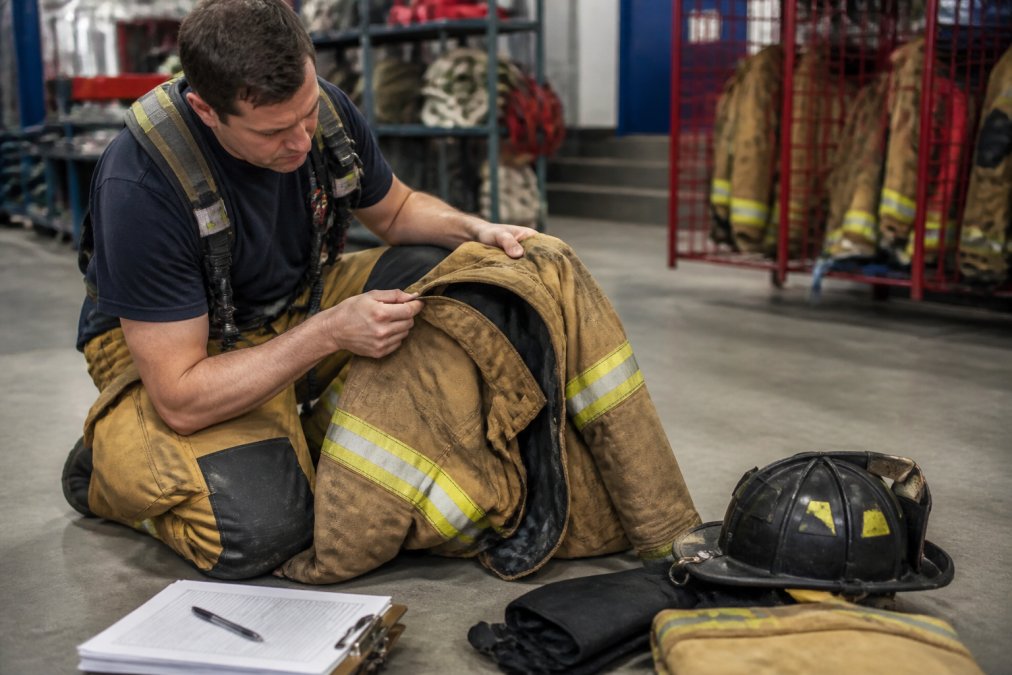
A routine visual inspection is not a glance. It is a structured pass over every element of the ensemble, performed after each use and before the gear goes back on the rack. Work top to bottom so nothing gets skipped:
- Helmet: Shell for cracks, crazing, or heat deformation; suspension and retention straps for stretching or fraying; reflective markers for secure attachment and legibility.
- Hood: Fabric for holes, thinning, or burn marks; fit around the face opening.
- Coat and pants: Outer shell for tears, abrasion, and charring; reflective trim for lifting edges, cracking, or loss of retroreflectivity; hook-and-loop and zipper closures for function; stress points at shoulders, elbows, knees, and cuffs.
- Gloves: Barrier for punctures or stiffness; grip surface for glazing or hardening.
- Boots: Sole separation, toe cap integrity, and puncture-resistant midsole condition.
- SCBA interface: The seal where the facepiece meets the hood and the coat collar, a gap here defeats the ensemble.
Advanced Inspection: What Only a Certified Technician Can Do
Advanced inspection goes beyond what the eye can catch. A certified technician evaluates thermal degradation in the outer shell and thermal liner, tests seam integrity under load, and measures reflective trim performance against the standard. These are the failures that hide behind intact fabric, the coat that looks serviceable but has lost its protective capacity.
Cleaning Frequency Drives Inspection Frequency
Cleaning frequency drives inspection frequency. A heavily soiled coat needs decontamination before it can be properly inspected, because soot masks thermal damage. Contaminants also degrade the fabric itself, so a coat that stays dirty between cleanings is aging faster than its maintenance log suggests. Build cleaning into the inspection cycle rather than treating it as a separate chore.
Digitizing the Checklist for 2026 Compliance
The 2026 compliance environment rewards verifiable records tied to each garment's service life.
Fire Helmet Maintenance Best Practices for Long Service Life
Fire helmet maintenance best practices come down to three habits: inspect the shell for cracking, keep the suspension and retention system clean and functional, and never expose the helmet to solvents that degrade the shell material.
Documentation, Record-Keeping, and Compliance for 2026
Record-keeping is where departments win or lose compliance reviews. Every piece of turnout gear needs a file that traces its full life: purchase date, every inspection, every cleaning, every repair, and the eventual retirement date.
Retirement Criteria and Decommissioning Your Gear
Retirement criteria are not purely calendar-based, though service life sets the outer limit. Gear retires when it fails inspection, when it is contaminated beyond cleaning, or when it reaches the end of its defined service life regardless of appearance.
The Clock Starts at Manufacture, Not Issuance
Structural firefighting ensembles have a maximum service life defined in the standard, and that clock starts at the manufacture date on the label, not the date your department issued it. Gear that sat in a warehouse for two years has already spent two years of its life.
Contamination and Damage Retirement
Gear contaminated beyond cleaning retires immediately, no matter its age. The same applies to gear that fails advanced inspection, thermal degradation, seam failure, or barrier compromise cannot be repaired back to service. When in doubt, the standard's default is retirement, not repair.
Decommissioning: Making Retirement Permanent
Decommissioning means the gear can never return to service. Cut it, mark it, or destroy it. Retired turnout gear that ends up back in a station locker is a liability waiting to happen.
A defensible decommissioning process does three things:
- Removes the garment from the active inventory in the same record system that tracked its inspections.
- Physically renders it unusable so it cannot be mistaken for serviceable gear.
- Documents the retirement with the date, the reason, and the person who authorized it.
The Liability Side Nobody Talks About
Most compliance guides stop at the technical standard. The legal exposure is where the stakes actually live. Under OSHA's 29 CFR 1910.132 PPE requirements, the employer has a duty to provide and maintain protective equipment, and "maintain" includes removing damaged or defective gear from service. A department that keeps degraded gear in rotation is not just out of step with the standard; it is exposed on the employer-duty side of that regulation.
Budgeting, Supply Chain, and Digital Inspection Tools
Budgeting for 2026 upgrades is the angle most compliance guides skip entirely. Replacement cycles collide. If a department bought a full complement of gear in one year, every piece retires in the same year, and that creates a budget cliff.
Frequently Asked Questions
What are the major changes to fire service gear inspection standards in 2026?
The 2026 updates emphasize digital documentation and tighter timelines for advanced inspections. NFPA 1850 now requires departments to maintain electronic maintenance logs that track every inspection, cleaning, and repair. The standards also clarify that gear must be inspected after every use involving contamination or suspected damage, not just on a fixed calendar. Check with your department's safety officer for the specific compliance deadlines that apply to your inventory.
How often should turnout gear be inspected according to NFPA standards?
Routine visual inspections happen after every use and at least monthly. Advanced inspections by a certified technician are required annually, or sooner if the gear shows signs of thermal degradation, contamination, or physical damage. The turnout gear inspection checklist should include checks for rips, seam integrity, reflective trim condition, and moisture barrier function. Any gear that fails a routine check gets pulled from service immediately.
What is the difference between routine and advanced PPE inspections?
Routine inspections are visual and tactile checks any firefighter can perform: looking for tears, burns, discoloration, and loose stitching. Advanced inspections require a certified technician who tests moisture barriers, thermal liners, and seam strength using specialized equipment. Advanced inspections also verify that reflective trim and labeling requirements still meet NFPA 1851 inspection requirements. Both types must be logged in your department's record-keeping system.
Does the 2026 update affect helmet inspection requirements?
Yes. The 2026 standards reinforce that helmets must be inspected for shell cracking, impact damage, and degradation of the suspension system. Reflective decals and tetrahedrons should be checked for peeling or fading, since they affect visibility on scene. If your helmet has a leather front holder or custom accessories, verify they remain securely attached and do not interfere with the helmet's protective function. Replace any component that shows structural compromise.
What documentation is required for annual fire gear inspections?
You need a maintenance log for each piece of gear that records the date, inspector name, findings, and any corrective action taken. Advanced inspections should include the certified technician's credentials and test results. NFPA 1850 also requires retention of cleaning and repair records for the life of the gear. Many departments now use digital inspection software to timestamp entries and flag gear that is due for retirement.
How do I identify when fire service gear needs to be retired?
Retirement criteria include exceeding the manufacturer's service life (typically 10 years for structural turnout gear), failing an advanced inspection, or sustaining damage that cannot be safely repaired. Contamination from hazardous materials may also require retirement if decontamination is unsuccessful. Document the retirement date and reason, then remove the gear from service so it cannot be mistakenly reissued.
Compliance in 2026 is a documentation problem as much as an inspection problem. Departments that treat gear maintenance as a paper trail, not a chore, pass audits and keep firefighters safer. EH Coverings builds American-made helmet accessories designed to fit MSA, E.H. Coverings, Cairns, and Morning Pride helmets, with customization options and construction meant to last a full career. Get started with EH Coverings and equip your crew with gear that holds up to inspection and to the job.