

Table of Contents
- What Makes Fire Helmet Accessories Durable
- Material Matters: Leather, Brass, and Thermoplastic
- Durability Testing Protocols You Should Know
- Quick Comparison: Top Durable Fire Helmet Accessories
- Brass Helmet Front Holders: Long-Term Value and Fit
- Installing Brass Helmet Hardware: Step-by-Step
- Fire Helmet Maintenance Tips for Leather and Brass
- Weight and Balance: How Accessories Affect Comfort
- Frequently Asked Questions
Last Updated: September 17, 2026
What Makes Fire Helmet Accessories Durable
Durability in fire helmet accessories comes down to three things: the material it's made from, how it's fastened to the shell, and how well it survives repeated heat and impact cycles. Accessories that fail early usually fail at the attachment point first, not the body of the part.
At EH Coverings, we build brass front holders, seam bands, and leather brims for firefighters who plan to keep the same helmet for a full career.

Here's what actually separates durable accessories from disposable ones:
- Material thickness and grade, not just the material name
- Fastener quality, since rivets and bands take the load
- Fit tolerance, because a loose part wears faster than a tight one
- Heat and UV resistance in the specific component, not the helmet overall
The rest of this guide breaks down materials, testing, compatibility, and installation so you can judge durability before you buy, not after something cracks on a call.
Material Matters: Leather, Brass, and Thermoplastic
Leather, brass, and thermoplastic each fail differently, and that matters more than which one sounds toughest. Leather is a natural fiber that responds to conditioning and can be reshaped. Brass is a metal that work-hardens and resists corrosion but can bend under direct impact. Thermoplastic is molded and generally cheaper, but it degrades with heat cycling in a way leather and brass do not.
For structural firefighting, the practical split looks like this:
- Leather suits brims, front holder backing, and parts that need to flex without cracking
- Brass suits front holders, seam bands, and hardware where rigidity and weight are acceptable
- Thermoplastic suits lightweight clips and brackets where cost and weight matter more than longevity
A common mistake is mixing materials without thinking about how they expand at different rates. A brass band riveted into a leather helmet shell will move differently than the leather around it. That is normal and manageable, but it means the fasteners need to be sized for that movement, not just for a static fit.
Durability Testing Protocols You Should Know
Most buyers never see a durability test, which is exactly why it is worth asking what a manufacturer actually tested. There is no single universal test for helmet accessories, so the useful question is what the maker did to verify the part holds up in service.
In practice, durability claims usually rest on some combination of:
- Repeated flex testing on leather parts to check for cracking at stress points
- Pull testing on rivets and bands to confirm the fastener, not the material, is the weak link
- Heat exposure cycles to see how a component behaves after repeated warming and cooling
- Corrosion checks on brass hardware exposed to sweat and moisture
- Field testing by working firefighters before a part goes to full production
The gap most buyers miss is that a part can pass a material test and still fail in the field. A brass front holder that holds up fine on a bench can still loosen if the rivets were sized for a lighter helmet. Ask specifically about the fastener, not just the metal.

Quick Comparison: Top Durable Fire Helmet Accessories
The table below summarizes the accessories covered in this guide by material, price, and best use, so you can compare before reading the full sections.
| Accessory | Material | Price | Best For |
|---|---|---|---|
| Brass Seam Bands | Brass | $23.00 (set of 4) | Replacing worn seam bands on leather helmets |
| Brass Hardware | Brass | $6.00 (set of 5) | Front holder and crown rivet replacement |
| Suspension Tabs | $20.00 (set of 4) | Restoring or adding a suspension system | |
| Carved Front Holders for Service | Brass | $45.00 | Upgrading an in-service helmet |
| Natural Leather Brim | Leather with shaping wire | $325.00 | Long-term helmet restoration |
| Blemished Leather Brims | Leather with shaping wire | $150.00 | Budget restoration with minor cosmetic flaws |
| Reflective Helmet Decals | 3M premium reflective vinyl | $7.25-$9.10 | High-visibility marking and identification |
| Flashover Lids TL2 Conversion Kit | Composite band | $435.00 | Converting a Phenix TL-2 or TC-1 to a conventional liner |
Brass Helmet Front Holders: Long-Term Value and Fit
Brass helmet front holders are the single accessory most likely to outlast the helmet they're mounted on, provided the fit is right. The failure mode is almost never the brass itself. It is a holder that was forced onto a shell it was not sized for, which puts constant stress on the mounting points.

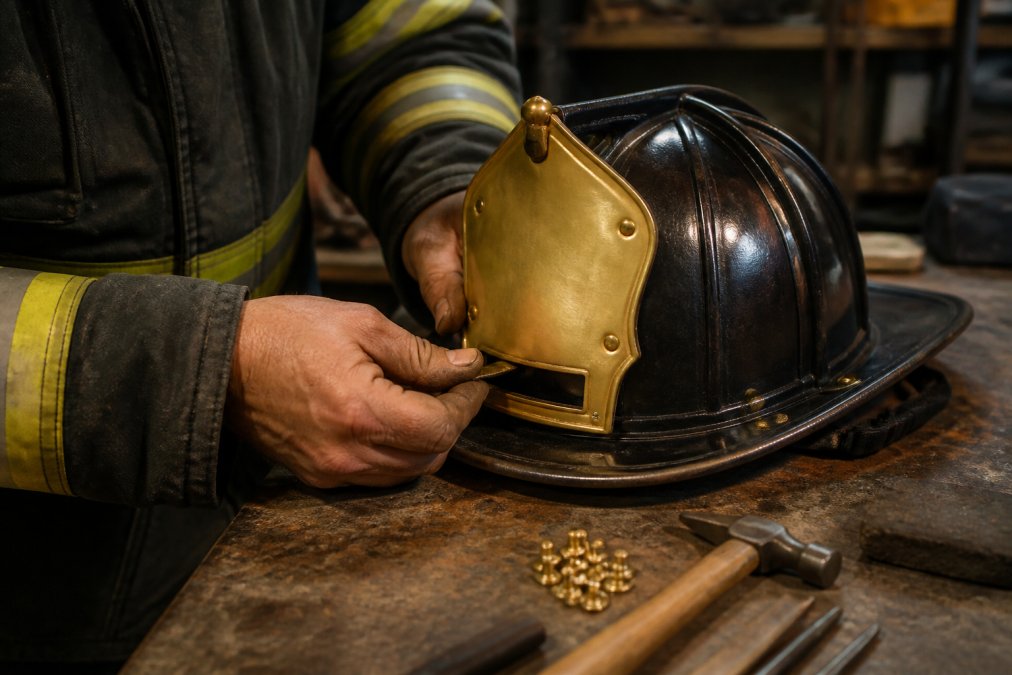
The Carved Front Holders for Service at $45.00 are built for upgrading an in-service helmet without replacing the whole thing. They're made from American materials in an American factory, and they're designed to fit the industry-standard helmet shells firefighters actually wear on duty.
One thing to know before ordering: the Liberty front holder fits only the Paul Conway American Heritage. That is a real compatibility limit, not fine print.
Compatibility Guide for Industry-Standard Helmets
Compatibility is where most online orders go wrong, so treat this as the first thing you verify. EH Coverings front holders are designed to fit MSA, E.H. Coverings, Cairns, and Morning Pride helmets. If your shell is one of those, the fit is straightforward. If it isn't, ask first.
Before ordering any front holder, confirm:
- Your helmet's manufacturer and model
- Whether your shell uses a standard or proprietary front holder mount
- The width of the front holder recess on your shell
- Whether your department allows non-issued front holders
- Whether you need a specific carving or a plain brass holder
Installing Brass Helmet Hardware: Step-by-Step
Installing brass hardware correctly takes about 20 to 30 minutes with basic hand tools, and the whole job hinges on getting the rivets seated evenly. Rushing this step is what causes loose front holders six months later.
What you'll need:
- Replacement brass rivets, such as Brass Hardware at $6.00 for a set of 5
- A rivet setter or a punch and hammer
- A soft backing block so you don't deform the shell
- A cloth to protect the leather finish
Common Installation Mistakes to Avoid
Over-tightening rivets to compensate for a holder that doesn't quite fit can deform the shell and create a new failure point.
Other frequent errors:
- Drilling new holes instead of matching existing ones
- Using hardware that isn't sized for the shell thickness
- Installing on a shell that's already cracked at the mounting point
- Skipping the backing block and crushing the leather from behind
Fire Helmet Maintenance Tips for Leather and Brass
Leather and brass both need periodic attention, but they need different kinds. Leather dries out and cracks without conditioning. Brass tarnishes and can develop corrosion in crevices where sweat collects.
A practical maintenance routine:
- Wipe brass hardware after heavy use to remove sweat and grime
- Condition leather parts a few times a year, more often in dry climates
- Check rivets and bands for looseness at the start of each season
- Inspect the brim edge for cracking where the shaping wire sits
- Replace seam bands as soon as they show separation, not after they fail
Weight and Balance: How Accessories Affect Comfort
Weight and balance affect comfort more than most firefighters expect, and the effect compounds over a long shift. A front holder adds weight at the front of the shell, which increases cervical strain over time. That is not a reason to skip the holder, but it is a reason to think about total weight rather than one part in isolation.
The practical rules:
- Keep front-of-shell weight modest. Brass is heavier than thermoplastic, and that weight sits where it stresses the neck most.
- Balance front additions with rear-mounted items where your department allows it.
- Avoid stacking multiple heavy accessories on the same shell.
- Check the suspension fit after adding weight, since a loose suspension makes the load worse.
Frequently Asked Questions
How long do fire helmets and their accessories last?
Fire helmet shells often last 10 years or more with proper care, but accessories wear faster. Leather brims and brass front holders from EH Coverings are built to last decades when maintained. Reflective decals and trim may need replacement every 3-5 years as adhesive and reflectivity degrade. NFPA 1851 requires advanced inspection of helmets and components, so check accessories during routine gear checks and replace worn parts promptly.
What are the most durable materials for fire helmet front holders?
Solid brass is the most durable material for fire helmet front holders. It resists corrosion, holds its shape under heat, and can be polished or restored rather than replaced. EH Coverings' carved brass front holders use American materials and fit MSA, Cairns, and Morning Pride helmets. Plastic alternatives crack under impact and heat stress, while brass front holders maintain structural integrity for the life of the helmet.
Are brass helmet accessories more durable than plastic alternatives?
EH Coverings' brass seam bands and hardware are made in America and designed to replace worn parts on leather helmets. While brass costs more upfront, it is a reliable choice for career firefighters.
How do you properly maintain leather and brass helmet gear?
Clean brass hardware with a soft cloth and mild brass polish to remove tarnish without scratching. For leather brims, wipe with a damp cloth and apply a leather conditioner sparingly to prevent drying and cracking. Inspect brass rivets and seam bands for looseness during routine checks. Store helmets away from direct sunlight and extreme heat. EH Coverings' leather brims are reinforced with shaping wire, so avoid bending or folding them during storage.