

Table of Contents
- Why American Made Fire Helmet Gear Still Matters on the Fireground
- How to Verify American Made Gear Before You Buy
- NFPA Standards for Fire Helmet Accessories You Need to Know
- Durable Leather Fire Helmet Accessories Built for a Career
- Shell Materials and Weight: Leather vs. Thermoplastic vs. Fiberglass Composite
- Fit, Sizing, and Comfort: Getting Your Head Protection Right
- Maintenance, Repair, and When to Retire Your Helmet
- Frequently Asked Questions
Last Updated: September 15, 2026
Why American Made Fire Helmet Gear Still Matters on the Fireground
When you're crawling a hallway in zero visibility, the last thing on your mind should be whether your gear was built to spec or to a price. American made fire helmet gear matters because it's held to a documented standard, made from traceable materials, and backed by makers who answer to the same fire service you do. This guide covers what to check, what to avoid, and how to make a helmet last a full career.
The fire service runs on trust: your department trusts you to show up ready, and you trust your equipment to hold up. That chain breaks the moment a helmet part fails, a front holder that snaps, a brim that warps, a suspension system that loosens mid-shift. None are dramatic in a catalog photo; all are dangerous on a fireground.
"American made" is not a single claim but a chain of claims. Material origin, assembly location, and quality control are three separate things, and a product can be honest about one while glossing over the other two.
How to Verify American Made Gear Before You Buy
Verifying American made gear comes down to three checks: material origin, assembly location, and who stands behind the warranty. Ask for all three in writing, not just a flag on a product page.
Start with the material. A brass front holder is either cast from domestic brass stock or it isn't. Leather is either tanned and finished domestically or imported. Ask the maker where the raw material comes from and whether that's documented.
Next, assembly. "Assembled in America" and "made in America" are different claims. Rivets set by hand in a domestic shop is a different product than hardware shipped in and bolted together here. Both can be legitimate; you deserve to know which one you're buying.
Finally, accountability. Who repairs it if it fails? A maker with a domestic facility and a repair path is a different risk profile than a marketplace listing with no address.
The Federal Trade Commission's guidance on Made in USA claims sets the standard for what those labels legally mean. If a seller can't explain how their product meets that bar, treat the claim as marketing until proven otherwise.
| What to Check | What "Yes" Looks Like | Why It Matters |
|---|---|---|
| Material origin | Domestic brass, leather, or hardware stock | Traceable supply chain |
| Assembly location | Named domestic facility | Verifiable labor and QC |
| Repair path | Maker services or replaces parts | Long-term accountability |
| Warranty terms | Written, specific, honored | Real recourse if it fails |
| Fit compatibility | Listed helmet models | No modification needed |
NFPA Standards for Fire Helmet Accessories You Need to Know
NFPA standards for fire helmet accessories exist to keep add-ons from compromising the helmet they're attached to. The core principle: anything you bolt onto a compliant helmet must not degrade its impact protection, retention, or thermal performance.
NFPA 1971 governs structural firefighting ensembles, including helmets, covering impact resistance, penetration resistance, heat and flame resistance, and retention system performance (NFPA 1971 Standard Development). When a manufacturer says a helmet is NFPA compliant, that's the benchmark they're claiming against.
NFPA 1977 covers wildland firefighting protective clothing and equipment, a lighter and different threat profile than structural work (NFPA 1977 Standard Development).
NFPA 1951 addresses technical rescue, another distinct use case.
The practical takeaway: accessories like front holders and shields are generally not independently certified the way a complete helmet is, so the burden falls on you and your department to confirm the add-on doesn't interfere with certified performance. A heavy, poorly mounted front holder can shift weight forward during a crawl, and a shield that blocks peripheral vision is a problem regardless of how good it looks.
Check with your department's safety officer before adding anything. Many departments have written policies about what can be modified on an issued helmet, and those policies usually trace back to the manufacturer's guidance.
Durable Leather Fire Helmet Accessories Built for a Career
Durable leather fire helmet accessories are built around a simple idea: a career is long, and the gear should outlast it. Leather brims, brass front holders, and carved shields hold up to heat, abrasion, and daily handling in a way cheaper substitutes don't.
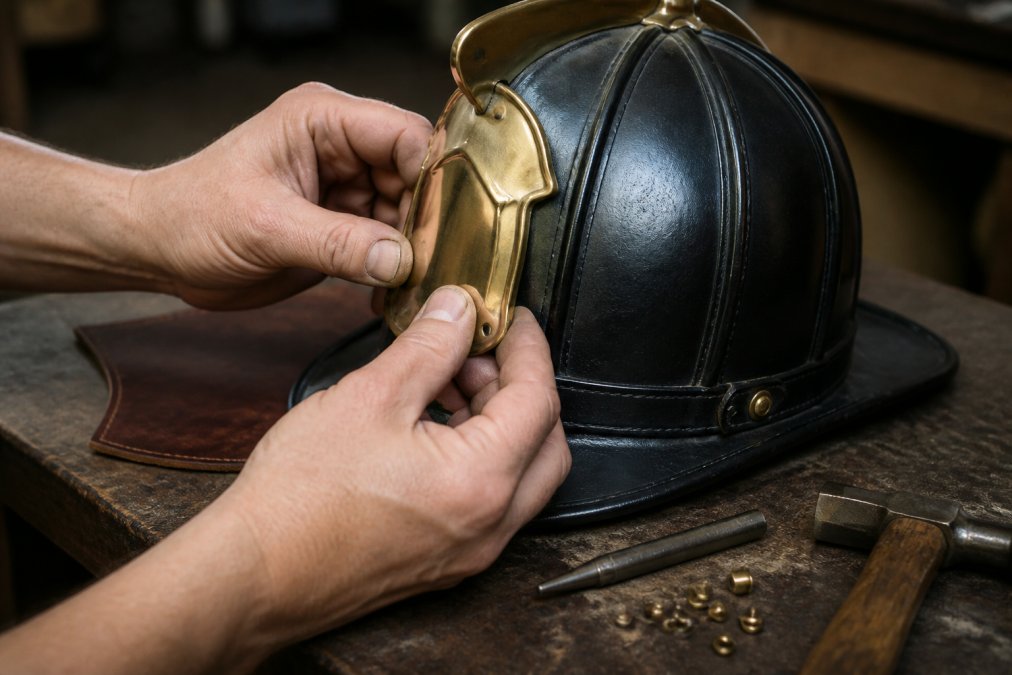
The difference shows up in the details: a leather brim reinforced with a shaping wire holds its curve instead of curling at the edges after a few hot shifts, properly cast and finished brass keeps its shape through repeated exposure, and hand-set rivets stay tight.
EH Coverings builds this category around domestic material and domestic labor. The All American Brass Front Holder ($65.00) is made from American material by American workers in an American factory, and it fits MSA and E.H. Coverings style leather helmets as well as the TL2, plus Cairns 1010 and 1044 and Morning Pride Ben 2. The Customizable All American Brass ($75.00) offers the same fit range in brass, matte black, or gloss black, with three rivets included for mounting.

For a full restoration, the Natural Leather Brim ($325.00) is cut from high-quality American leather with scroll work and a shaping wire sewn in place by hand. These are built to last decades, not seasons.
If budget is the constraint, the Carved Front Holders for Service ($45.00) let you upgrade an in-service helmet without a full rebuild. Same domestic material chain, lower entry point.
Shell Materials and Weight: Leather vs. Thermoplastic vs. Fiberglass Composite
Shell material determines weight, thermal behavior, and how the helmet ages. Leather is the traditional choice, thermoplastic is the lightest common option, and fiberglass composite sits between them on weight with strong rigidity. What most buying guides skip are the numbers behind those trade-offs, and those numbers drive neck strain over a career.
Comparative Weight, by Shell Type
Exact weights vary by manufacturer, shell size, and trim, but the ranges below reflect what most structural helmets fall into. Use them as a planning guide, not a spec sheet, always confirm the published weight for the specific model you're considering.
| Shell Type | Typical Shell Weight Range | Thermal Behavior | Service Life Expectation |
|---|---|---|---|
| Leather | Heaviest common option | Handles radiant heat well; breaks in over time | Career-length with proper conditioning |
| Thermoplastic | Lightest common option | Softens at lower temperatures; can lose structural memory | Shorter; replace sooner after heat exposure |
| Fiberglass composite | Mid-range | Stiff, impact-resistant, more heat-stable than most thermoplastics | Long, with inspection after significant heat events |
Practitioners commonly describe the difference between a light and heavy shell as most noticeable in the last hour of a long shift, not the first. Ounces on your head become neck strain, and that strain compounds when you add a brass front holder, a shield, ear covers, and a neck shroud. If you're running a heavy leather shell, keep the add-ons light; on a composite or thermoplastic shell, you have more headroom before total load becomes a problem.
How Each Material Ages
Leather shells are handcrafted from tanned hide and break in over time.
Matching Shell to Accessory
Fit, Sizing, and Comfort: Getting Your Head Protection Right
Maintenance, Repair, and When to Retire Your Helmet
Routine Care
Retirement Criteria: What Actually Ends a Helmet's Service Life
Repair vs. Replace
A Simple Inspection Routine
Frequently Asked Questions
How can you verify if fire helmet accessories are truly American made?
Look for a written country-of-origin claim, not just a flag graphic. Ask the seller where the raw materials come from, where the parts are formed, and where final assembly happens. Under FTC rules, a "Made in USA" claim means all or virtually all of the product is made here. A supplier that answers those three questions clearly is usually the real thing.
What standards do American fire helmet manufacturers follow?
Structural fire helmets are built to NFPA 1971, while wildland helmets follow NFPA 1977. Both cover impact protection, thermal resistance, retention systems, and face and eye protection. Accessories like brass front holders are not certified on their own, but they should not block the helmet's built-in protection or interfere with the suspension system or chin strap.
Are American made fire helmet components more durable?
Domestic makers often use heavier-gauge brass and full-grain leather, which hold up better to heat, sweat, and repeated handling. A solid brass front holder or reinforced leather brim can last a full career with basic care, while thinner imported parts may bend, crack, or lose their finish much sooner. Durability depends on material and construction, not the label alone.
Will brass front holders and leather accessories fit my existing helmet?
Fit depends on the helmet model. Common fits include MSA and E.H. Coverings leather helmets, the TL2, Cairns 1010 and 1044, and Morning Pride Ben 2. Measure the front holder slot and check the model before ordering. A maker that lists exact compatible helmets, or offers a fit check, saves you from drilling new holes or returning parts that never sat right.