

Table of Contents
- How Fire Helmet Materials Have Changed Over Time
- Leather vs. Composite vs. Thermoplastic: A Material Comparison
- NFPA 1971 Helmet Standards: What Every Firefighter Should Know
- Heat Resistance, Impact Protection, and Structural Integrity
- Weight, Ergonomics, and Comfort in Daily Use
- How to Restore Old Fire Helmets: Leather Brims, Brass, and Hardware
- Fire Helmet Maintenance and Inspection: Extending Service Life
- Cost-to-Lifespan: Why Material Choice Pays Off Over a Career
- Frequently Asked Questions
Last Updated: September 12, 2026
How Fire Helmet Materials Have Changed Over Time
Fire helmet construction has shifted from steam-era leather to engineered thermoplastics and fiberglass composites, each generation trading tradition for gains in heat resistance and impact protection. This guide from EH Coverings walks through the best materials for fire helmet gear, from shell composition to brass hardware.

That evolution matters because a helmet is not a single material. It is a shell, a thermal barrier, a Nomex lining, a retention system, and hardware that all age at different rates. According to NFPA 1971, Standard on Protective Ensembles for Structural Fire Fighting, helmets must survive radiant heat, impact, and penetration testing before they ever reach a firefighter.
The best materials for fire helmet gear balance heat resistance, impact attenuation, and a weight your neck can tolerate across a 24-hour shift, not durability alone.
Below, we break down how leather, composite, and thermoplastic shells perform, what NFPA 1971 requires, and how to get decades of service from a helmet you own.
Leather vs. Composite vs. Thermoplastic: A Material Comparison
No single shell material wins on every measure. Leather leads on durability and repairability, fiberglass composite on impact attenuation, thermoplastic on cost and weight. The right choice depends on call volume, inspection rules, and intended service life.
| Material | Heat Resistance | Impact Protection | Weight | Service Life | Cost to Replace |
|---|---|---|---|---|---|
| Traditional leather | High, chars slowly | Good | Heaviest | Decades with care | High |
| Fiberglass composite | High | Best | Moderate | 10-15 years | Moderate |
| Thermoplastic | Moderate | Good | Lightest | 5-10 years | Lowest |
Traditional Leather Shells
Leather remains the benchmark for long-term durability. A well-cared-for shell resists thermal degradation, holds its shape after repeated heating and cooling, and can be rebuilt rather than replaced. The trade-off is weight and upkeep: leather needs conditioning, and a soaked shell takes time to dry without warping.
Fiberglass Composite Shells
Fiberglass composite shells are built from resin-reinforced glass fibers, giving them the highest tensile strength of the three materials. That means strong impact attenuation and resistance to cracking under penetration loads. They are heavier than thermoplastic but lighter than most leather, and hold up well in burn tower environments.
Thermoplastic Shells
Thermoplastic shells are molded from synthetic polymers, making them inexpensive and light. The trade-off is heat resistance: thermoplastic softens at lower temperatures than leather or composite, so it suits training academies and low-call-volume departments rather than heavy structural firefighting.
NFPA 1971 Helmet Standards: What Every Firefighter Should Know
NFPA 1971 governs structural firefighting helmets in the United States, setting minimum requirements for heat resistance, impact protection, penetration resistance, and retention system strength. A helmet with the current edition's certification has passed laboratory testing for each category.
The standard sets a floor, not a ceiling: a thermoplastic and a leather shell can both pass, even though they behave very differently after a decade of service.
- Heat resistance: shell and components must withstand radiant and conductive heat without losing structural integrity
- Impact attenuation: the helmet must absorb energy from a falling object without transmitting it to the head
- Penetration resistance: the shell must resist sharp objects driven into the crown
- Retention: chin strap integrity is tested under load so the helmet stays in place during a fall
PPE compliance is a department responsibility. Check the certification label inside the shell and confirm it reflects the edition your department requires.
Heat Resistance, Impact Protection, and Structural Integrity
Structural integrity ties heat resistance and impact protection together: a thermally degraded shell may look intact while losing the strength to absorb an impact. That is why thermal degradation is the quiet failure mode in fire helmet gear, and why each material's failure mechanism matters more than the marketing label.
How heat actually attacks a shell
Heat reaches a helmet in two forms that stress materials differently. Radiant heat loads the shell surface from a distance, so a helmet can degrade in flashover without direct flame contact. Conductive heat transfers through direct contact with a hot surface, such as a heated wall or downed ceiling member. NFPA 1971 tests for both, and passing one does not mean excelling at the other.
- Leather chars progressively. The outer fibers carbonize and form an insulating layer that slows further heat penetration, which is why leather shells hold their shape after repeated heating and cooling cycles. The trade-off is that charred leather loses tensile strength where it has burned.
- Fiberglass composite relies on the resin matrix to hold glass fibers in tension. At sustained high temperatures the resin can soften or outgas before the fibers themselves fail, which is why composite shells can pass a single heat test yet show reduced stiffness after repeated exposures.
- Thermoplastic softens at a defined glass-transition temperature. Below that point it performs well; above it, the shell can deform permanently. This is why thermoplastic is a training and low-call-volume choice rather than a heavy structural shell.
Impact attenuation is about energy management, not hardness
A shell stops a falling object by flexing, distributing the load across a wider area, and recovering its shape, not by being hard. Fiberglass composite distributes a blow across the weave and resin matrix, so it tends to lead on impact attenuation. Leather absorbs energy through thickness and density. Thermoplastic relies on molded geometry, which can crack rather than flex under a hard, concentrated strike.
Penetration resistance is separate: a shell can resist a broad impact and still fail a sharp, driven object. NFPA 1971 tests penetration separately, and the certification label reflects the combined result, not a single score.
The degradation you cannot see
What most guides skip is what happens after the fire is out. Synthetic composites and thermoplastics absorb and retain combustion byproducts, soot, and chemical residue in their surface layers, suspension, and lining. Leather is porous and holds contamination too, but its surface can often be cleaned and conditioned more aggressively. Decontamination after every significant exposure is a health control, not a cosmetic routine: a helmet that passes visual inspection can still be a chemical reservoir against the skin.
What this means for material choice
Match the material to the thermal and impact profile of the work, not a single durability claim. High radiant and conductive heat with repeated impact loads favors leather or fiberglass composite. Training environments with controlled exposure and lower call volume are where thermoplastic's weight and cost advantages outweigh its lower thermal ceiling. The inspection interval matters as much as the material: a well-maintained thermoplastic in light service can outlast a neglected composite in heavy service.
Weight, Ergonomics, and Comfort in Daily Use
Ergonomics decide whether you wear the helmet correctly on hour twelve of a shift. A heavier shell increases neck strain over a career, but weight distribution matters more than total ounces: a well-balanced leather helmet with a properly fitted suspension can feel lighter than a poorly balanced composite.
Fit factors that affect comfort and safety:
- Suspension adjustment: the headband should sit level, roughly an inch above the eyebrows
- Chin strap integrity: a loose strap lets the helmet shift during overhaul and reduces protection
- Weight distribution: front-loaded hardware pulls the brim down; keep front holders balanced
- Visor protection: a properly seated visor should not interfere with the brim or retention system
- Low-profile design: reduces snagging on SCBA and door frames without sacrificing coverage
A common mistake is sizing a helmet once and never revisiting it. Suspension webbing stretches, headbands loosen, and a helmet that fit in the academy may not fit five years later.
How to Restore Old Fire Helmets: Leather Brims, Brass, and Hardware
Restoring an old fire helmet comes down to three components: the leather brim, the brass hardware, and the seam bands that hold the shell together. Replacing worn parts is far cheaper than a new helmet and preserves a proven shell.

Start by inspecting the brim for cracks, delamination, and flattened scroll work. A leather brim with a shaping wire sewn in place holds its curve far better than an unsupported one, which is why quality replacement brims are reinforced rather than flat-cut.
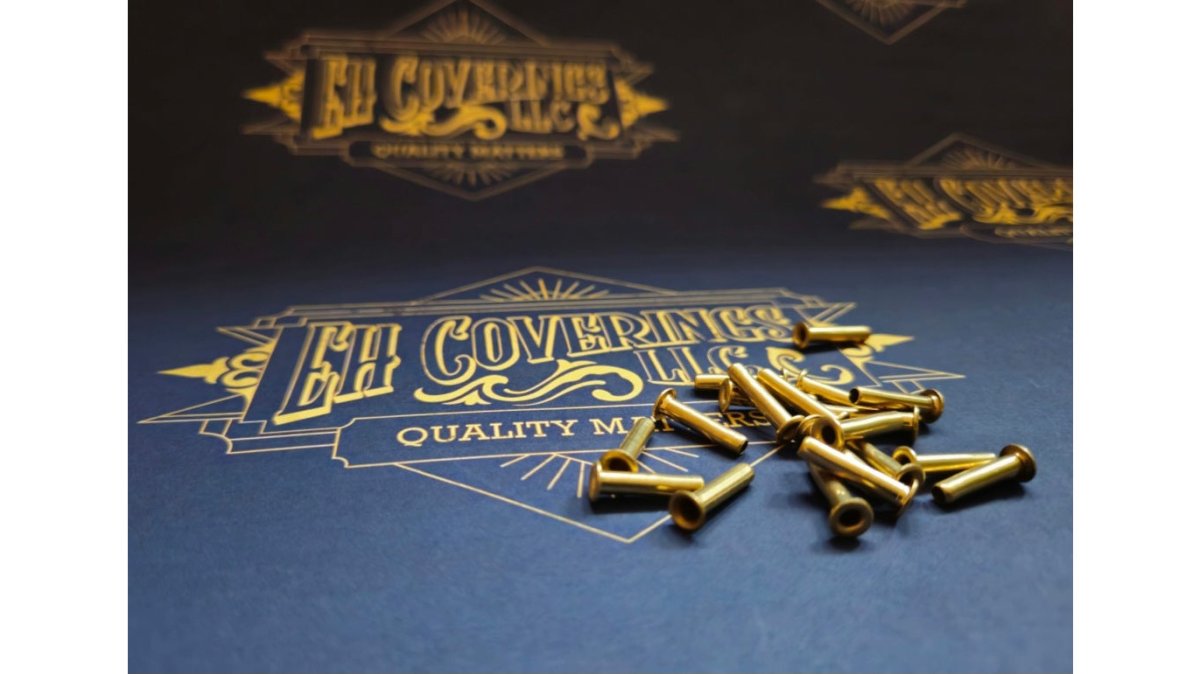
Next, address the brass. Front holders, rivets, and seam bands loosen, tarnish, or break first. Replacing them restores both the look and the structural attachment of the front holder.
- Inspect the brim for cracks, delamination, and warping
- Check the shaping wire for bends or breaks
- Replace worn seam bands before they fail
- Re-rivet any loose front holder or crown hardware
- Condition the leather and let it dry away from direct heat
EH Coverings builds replacement parts for exactly this job, including a Natural Leather Brim cut from American leather and reinforced with a shaping wire, and Brass Seam Bands made to replace worn or broken bands on leather helmets. For a budget-conscious rebuild, Blemished Leather Brims carry slight cosmetic defects at a lower price.

Fire Helmet Maintenance and Inspection: Extending Service Life
Fire helmet maintenance is a routine, not a one-time event. Inspect the shell, suspension, and hardware after every significant exposure, and document what you find. Decontamination belongs in that routine too: carcinogen exposure from soot on helmets is a known risk, and wiping down a shell after a fire is a basic control.
What to check and how often:
| Component | Check | Frequency |
|---|---|---|
| Shell | Cracks, crazing, thermal damage | After every fire |
| Suspension | Stretch, broken stitching | Monthly |
| Chin strap | Fraying, buckle function | Monthly |
| Hardware | Loose rivets, tarnished brass | Quarterly |
| Lining | Contamination, wear | Quarterly |
Service life varies by material. Thermoplastic shells typically see 5-10 years of structural service. Fiberglass composite shells run 10-15 years. Leather shells, maintained properly, can last a full career (nfpa.org).
What most guides miss is that hardware fails before shells do. A front holder held on by loose rivets is a snag hazard, and a broken seam band can let the brim separate from the shell. Replacing a set of Brass Hardware costs less than a shift's coffee and takes minutes to install.
Cost-to-Lifespan: Why Material Choice Pays Off Over a Career
Cost-to-lifespan matters more than sticker price. A thermoplastic shell that costs least up front may need replacing every five to seven years, while leather or composite can serve a full career with periodic hardware replacement. The gap is not just shell price: it is shell price plus hardware, fitting labor, downtime, and the decontamination burden of a helmet that has absorbed years of fireground exposure.
Running the math over a career
A common pattern in departments that track replacement cycles:
- Thermoplastic: structural service life of roughly 5-10 years depending on call volume and exposure. Over a 25-year career that is three to five shell replacements, each requiring new suspension, new hardware, and a refit.
- Fiberglass composite: structural service life of roughly 10-15 years. Over the same career that is one to two shell replacements, with hardware and suspension service in between.
- Leather: with proper conditioning and hardware replacement, a leather shell can serve a full career. The shell is rebuilt rather than replaced, which means the front holder, seam bands, and brim you buy today can stay with the same helmet for decades.
The labor and downtime line is the one most comparisons omit. Every replacement means the firefighter is out of a compliant helmet until the new one is fitted, and every new shell means re-buying custom hardware and re-mounting front holders. A department that replaces cheap shells four times also re-buys four sets of brass, the hidden multiplier.
The health and decontamination cost
A second cost does not show up on a purchase order: contamination retention. Synthetic composites and thermoplastics hold combustion byproducts and chemical residue in their surface layers, and that residue accumulates with each exposure. A shell replaced more often is discarded before it becomes a long-term chemical reservoir; a shell kept for a career has to be decontaminated aggressively and inspected for contamination. Leather's repairability cuts both ways: it can be cleaned and conditioned, but it is porous, so a heavily exposed leather shell needs the same decontamination discipline as any other material.
The practical takeaway: cost-to-lifespan and contamination management are the same conversation. A durable shell only pays off if the maintenance routine that keeps it in service also keeps it clean.
Cold-weather performance, the overlooked variable
Most cost comparisons assume a temperate environment. In cold weather, thermoplastic can become more brittle, raising the risk of cracking under impact (PubMed). Leather can stiffen until it warms, and a soaked leather shell that freezes can warp if not dried properly. Fiberglass composite holds its properties across a wider temperature range, which is why it is common in departments operating in both extremes. If your department runs cold-weather calls, that durability advantage belongs in the cost-to-lifespan math.
What the math actually favors
Leather and composite shells hold their value in a way thermoplastic does not. A restored leather helmet with quality brass is gear a firefighter keeps, not a disposable item, and the hardware transfers across rebuilds rather than being re-bought with every shell.
EH Coverings makes American brass front holders and leather accessories designed to fit MSA, E.H. Coverings, Cairns, and Morning Pride helmets, so the hardware you buy today still fits the helmet you replace in a decade. The All American Brass Front Holder fits Cairns 1010 and 1044 as well as Morning Pride Ben 2, and the Customizable All American Brass lets you match a department's artwork in brass, matte black, or gloss black.
Frequently Asked Questions
What materials are used to make firefighter helmets?
Modern firefighter helmets use three main shell materials: traditional leather, fiberglass composite, and thermoplastic. Leather shells come from tanned cowhide, often reinforced with a shaping wire and brass hardware. Composite shells combine fiberglass with resin for a rigid structure. Thermoplastic shells are molded from synthetic polymers that soften when heated. Each material meets NFPA 1971 standards but performs differently in heat resistance, impact attenuation, and service life expectancy.
What are the NFPA 1971 standards for fire helmet materials?
NFPA 1971 sets minimum performance requirements for structural firefighting helmets, including heat resistance, impact attenuation, penetration resistance, and chin strap integrity. The standard requires shells to withstand thermal degradation without losing structural integrity. It also mandates specific testing for visor protection, ear covers, and retention systems. Helmets must pass a series of lab tests before earning certification. Fire departments should verify that any replacement parts or accessories maintain the helmet's original NFPA compliance.
Are leather fire helmets still safe for modern firefighting?
Yes. Leather shells that meet NFPA 1971 are certified for structural firefighting. Leather offers natural heat resistance and a low-profile design that many firefighters prefer. The material develops a patina over time but retains tensile strength when properly maintained. The main trade-off is weight and cost compared to composite or thermoplastic options. Regular fire helmet maintenance and inspection, including checking for cracks, delamination, and hardware integrity, keeps leather helmets in service for decades.
How do I restore an old fire helmet without compromising safety?
Restoration focuses on replacing worn or broken components while preserving the shell. Start by inspecting the shell for cracks or thermal degradation. Replace brass seam bands, rivets, and front holders with American-made parts designed to fit your helmet model. A natural leather brim with scroll work can bring back the classic look of helmets from decades past. Avoid painting or coating the shell, which can hide damage and interfere with NFPA compliance. After restoration, have the helmet inspected by a qualified officer.