

Table of Contents
- What the FTC Made in USA Standard Actually Requires
- How to Verify American Made Gear Step by Step
- How to Spot Fake Made in USA Labels on Gear
- Supply Chain Transparency and Third-Party Certifications
- American Made Firefighting Equipment: Why Origin Matters
- Your Legal Recourse When a Made in USA Claim Is False
- How to Find Verified American Made Gear You Can Trust
- Conclusion
Last Updated: August 28, 2026
Verifying that a piece of gear is genuinely American made is harder than it sounds. Labels lie, marketing copy misleads, and the supply chain behind even the most patriotically branded products can stretch across multiple continents. At EH Coverings, we build brass front holders and leather helmet accessories from all-American materials, made by American workers in an American factory, so we understand exactly what that claim requires, and exactly how easy it is to fake. This guide breaks down how to verify american made gear with the same rigor a procurement officer would apply, from reading FTC standards correctly to pulling import records and demanding supply chain documentation.

What the FTC Made in USA Standard Actually Requires
The FTC Made in USA standard is the federal benchmark that governs domestic origin claims on consumer and commercial products.
The 'All or Virtually All' Rule Explained
The FTC's "all or virtually all" standard means that a product must have all significant parts, processing, and labor originating in the United States. "Virtually all" is not a loophole; the FTC interprets it to mean that any foreign content must be negligible and not form a significant part of the product's total manufacturing cost.
According to FTC Made in USA labeling requirements, the Commission evaluates claims based on the total cost of production, the proportion of foreign-sourced components, and how far removed the foreign content is from the finished product. A brass buckle sourced overseas on a domestically assembled belt can disqualify the entire product from an unqualified "Made in USA" claim. If a manufacturer cannot account for where every significant raw material originated, their unqualified claim is legally vulnerable.
'Made in USA' vs. 'Assembled in USA': A Critical Difference
"Assembled in USA" is a qualified claim, meaning the final assembly happened domestically but components may be foreign-sourced. This is not the same as "Made in USA," and the difference matters enormously for gear that needs to perform under pressure.
| Claim | What It Means | Foreign Content Allowed |
|---|---|---|
| Made in USA (unqualified) | All or virtually all domestic | Negligible only |
| Assembled in USA | Final assembly domestic | Yes, significantly |
| Made in USA with imported parts | Partial domestic content | Yes, disclosed |
| Designed in USA | Design only domestic | Yes, fully |
A product labeled "Designed in USA" or "Assembled in USA from globally sourced components" is transparent. The problem is when manufacturers use "Made in USA" imagery and language while quietly qualifying the claim in fine print.
How to Verify American Made Gear Step by Step
Verification of american made gear is a process, not a single check. Run through these steps in order before trusting any domestic origin claim.
Step 1: Read the Product Label Correctly
Start with the physical label. "Made in USA" without qualifiers is the strongest claim. Any additional phrase like "with imported components" or "assembled in USA" signals a qualified claim and requires deeper scrutiny.
Check the country of origin on the label against the packaging and product itself. Discrepancies are a red flag. For textile and leather goods, the FTC requires country of origin labeling on the product itself, not just the packaging.
- Look for the FTC-required label on the product, not just the hang tag
- Note the exact wording; every word in a domestic content claim is deliberate
- Check for a registered manufacturer address; a P.O. box alone is insufficient
- Cross-reference the label claim with the company's website and product spec sheets
Step 2: Check Customs and Import/Export Records
Import and export records are public documents. The U.S. Customs and Border Protection agency maintains records of all commercial shipments entering the country, and several databases aggregate this data for consumer and business research.
Search the manufacturer's company name in an import database. If a company claims domestic manufacturing but shows regular inbound shipments of the exact components their product uses, that is a significant discrepancy. Look for the Harmonized Tariff Schedule codes that match the product category; brass hardware, leather goods, and textile components each have specific codes.
According to U.S. Customs and Border Protection import records, importers are required to declare the country of origin for all goods entering commerce. Those records are traceable.
Step 3: Use Digital Verification Tools
Several digital tools make verification faster and more reliable.
- Import Yeti and Panjiva: These platforms aggregate U.S. import records and let you search by company name, product type, or port of entry. A manufacturer claiming domestic production who shows heavy import activity for their core materials deserves scrutiny.
- USDA BioPreferred Program database: For bio-based products, this federal database lists verified domestic content.
- Made in USA Certified registry: A third-party certification body that independently audits manufacturers before granting certification.
- Better Business Bureau: Check complaint history for labeling misrepresentation claims against specific brands.
Absence of import records is not proof of domestic manufacturing; it may simply mean the company is too small to appear in aggregated databases. Use these tools to catch problems, not to confirm compliance.
Step 4: Ask the Manufacturer Directly
A manufacturer with genuine domestic production should answer these questions without hesitation:
- Where are your raw materials sourced, and can you name the domestic suppliers?
- Where does final assembly occur, and is that facility owned or contracted?
- Do you have third-party certification for your domestic content claim?
- Can you provide a Bill of Materials showing component origins?
A company that deflects, provides vague answers, or cites "proprietary supply chain information" is giving you a signal. Legitimate domestic manufacturers are typically proud of their supply chain and happy to discuss it.
How to Spot Fake Made in USA Labels on Gear
The biggest mistake most buyers make is assuming that a flag graphic and patriotic language constitute a domestic origin claim. They do not.
Common Deceptive Labeling Tactics
Implied origin through imagery: American flags, bald eagles, and red-white-blue color schemes create a domestic impression without making a legal claim.
Geographic misdirection: "Headquarters in [U.S. city]" says nothing about where the product is manufactured.
Selective true statements: "Our quality control team is based in the USA" or "Inspected in the USA" are true but irrelevant to manufacturing origin.
Buried qualifications: The unqualified "Made in USA" appears prominently in marketing copy. The qualifier appears in the product spec sheet in smaller font.
Visual Identification: What Domestic Quality Looks Like
Domestically manufactured brass hardware typically shows consistent machining marks, uniform finish, and tight tolerances. Casting flash not cleaned up suggests lower-quality production processes more common in high-volume overseas manufacturing.
For leather goods, domestic tanneries produce leather with consistent grain patterns and tight fiber structure. Edges on domestically cut leather are typically clean and finished, not raw. Hardware attachment points on quality domestic goods show tight, flush riveting rather than loose or uneven fastening.
These are indicators, not proof. Use them alongside documentation.
Supply Chain Transparency and Third-Party Certifications
Supply chain transparency is the honest manufacturer's best marketing tool. A company that can trace every component from raw material to finished product has nothing to hide.
Third-party certification provides independent verification that a company's domestic content claims have been audited. The Made in USA Certified program conducts facility inspections and supply chain audits before granting certification. Certification must be renewed, ensuring ongoing compliance.
For fire service gear specifically, look for manufacturers who can provide:
- Certificates of conformance from domestic material suppliers
- Facility addresses that match OSHA-registered manufacturing locations
- Documentation of the final assembly location
- NFPA compliance documentation, which often requires traceability of materials
According to National Fire Protection Association standards overview, certain fire service equipment must meet documented manufacturing and material standards, creating a natural paper trail that legitimate domestic manufacturers maintain.
American Made Firefighting Equipment: Why Origin Matters
The origin of firefighting equipment is not a political statement. It is a performance and safety question.

Domestic manufacturing of fire service gear typically operates under closer regulatory oversight, with traceability requirements that overseas production often cannot match. When a component fails in the field, knowing where it was made and who made it is the starting point for accountability.
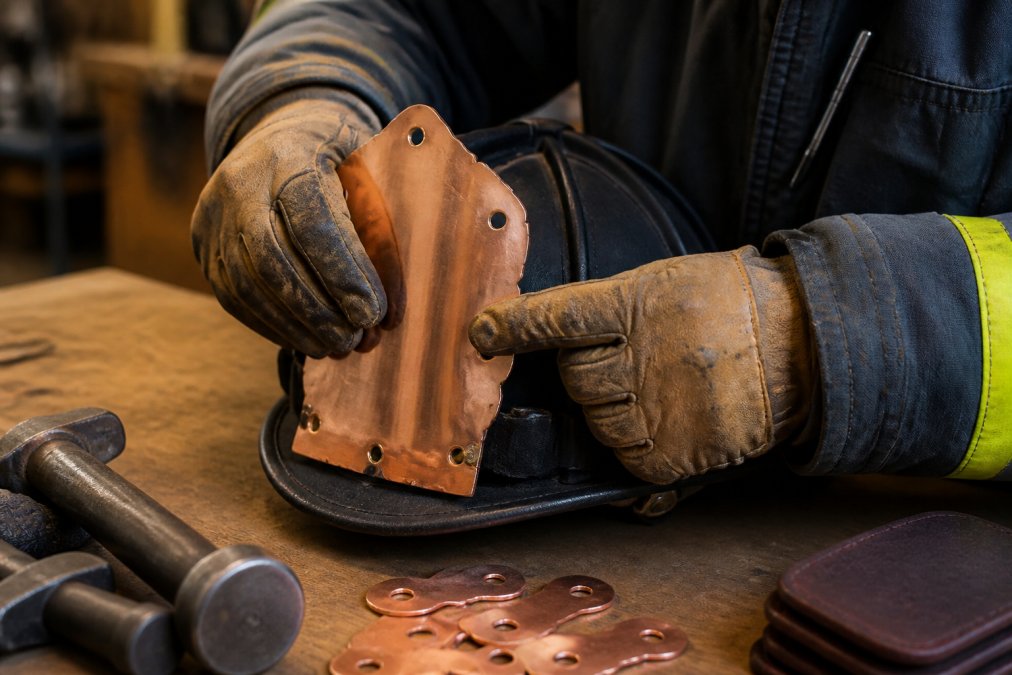
For career firefighters, gear longevity is a practical concern. Equipment built to last a career pays for itself over time. The EH Coverings All American Brass Front Holder, priced at $65.00, is built from all-American brass by American workers and designed to fit MSA, Cairns 1010 and 1044, Morning Pride Ben 2, and E.H. Coverings style leather helmets. The Brass Seam Bands, at $23.00 for a set of four, replace worn or broken seam bands on leather helmets using the same American-made brass. These are structural components that hold a helmet together.

Ethical manufacturing and domestic production are connected. A company that pays American wages, operates under American workplace safety regulations, and sources American raw materials is accountable in ways that overseas manufacturers simply are not.
Your Legal Recourse When a Made in USA Claim Is False
A false "Made in USA" claim is an FTC violation. Consumers and businesses have real options when they discover a domestic origin claim that does not hold up.
File an FTC complaint: The FTC accepts complaints about deceptive labeling at their consumer reporting portal. Complaints are aggregated and used to identify patterns of deceptive marketing.
State consumer protection laws: Many states have their own consumer protection statutes that parallel or exceed FTC standards. State attorneys general can and do pursue enforcement actions.
Class action litigation: False labeling claims have been the basis for class action lawsuits. If you purchased a product based on a false domestic origin claim, you may have standing to join or initiate a class action.
Retailer accountability: Retailers who sell falsely labeled products can also be held responsible.
As documented in FTC enforcement actions on Made in USA claims, the Commission has pursued enforcement against companies making false domestic origin claims, resulting in consent orders, fines, and required corrective advertising.
How to Find Verified American Made Gear You Can Trust
Finding genuinely domestic gear requires a different approach than simply searching "American made" on a retail platform.
Start with certification registries: The Made in USA Certified database lists manufacturers who have passed third-party audits.
Buy direct from manufacturers: Buying directly eliminates the retailer layer and gives you direct access to documentation.
Prioritize transparency over claims: A manufacturer who publishes their supply chain, names their material suppliers, and shows their production facility is demonstrating transparency.
Use the verification steps above before purchasing: Reading the label, checking import records, using digital tools, and asking direct questions will surface problems before you spend money.
For fire service personnel specifically, the combination of NFPA traceability requirements and the accountability that comes with domestic manufacturing makes verified American made gear the defensible choice.
Verifying american made gear takes more than reading a label, but it is not complicated once you know what to look for. The FTC standard is clear, import records are public, and legitimate domestic manufacturers welcome the scrutiny. For firefighters who need equipment that performs and lasts, EH Coverings produces brass front holders and leather helmet accessories from all-American materials, made by American workers, with the supply chain documentation to back it up. Add to cart and get gear you can account for at every level.

Frequently Asked Questions
What are the FTC requirements for a 'Made in USA' label?
The Federal Trade Commission requires that a product labeled 'Made in USA' must be 'all or virtually all' made in the United States. That means all significant parts, processing, and labor must originate domestically. Foreign-sourced components are only acceptable if they represent a negligible portion of the total manufacturing cost. Products that don't meet this standard must use a qualified claim, such as disclosing the percentage of domestic content or specifying which parts are imported.
What is the difference between 'Made in USA' and 'Assembled in USA'?
A 'Made in USA' claim requires that all or virtually all of the product's parts and labor are domestic. 'Assembled in USA' means the final assembly happened domestically, but the components may be foreign-sourced. For American made firefighting equipment, this distinction matters: a brass front holder assembled from imported brass carries a fundamentally different supply chain than one made from raw materials sourced and processed entirely within the country.
How can I spot fake 'Made in USA' claims on gear?
Start by reading the full label, not just the flag graphic. Vague phrases like 'American quality' or 'designed in the USA' are not origin claims. Check whether the manufacturer discloses raw material sourcing and factory location. Search the company's name in import/export databases like ImportYeti or Panjiva to see whether they ship goods from overseas. Brands committed to domestic manufacturing will answer direct questions about their supply chain without hesitation.
Why does the origin of firefighting gear matter for safety and durability?
Domestic manufacturing means the product is subject to federal consumer protection and labeling compliance standards enforced by agencies like the FTC and CPSC. For firefighters, gear that meets domestic manufacturing standards is more likely to be traceable, consistently quality-checked, and built to last under high-stakes conditions. Imported components with inconsistent quality assurance can introduce failure points in equipment that firefighters depend on every shift.
This article was written using GrandRanker