

Table of Contents
- Understanding Material Quality and Leather Weight for Helmet Bands
- How to Measure Fire Helmet for Band Sizing
- Customization Options: Text, Initials, and Unit Numbers
- Selecting Color, Thread, and Reflective Features
- Attachment Methods: Elastic Cord vs. Fixed Hardware
- Maintaining Leather Fire Gear for Long-Term Durability
- Ensuring Compatibility with Your Helmet Type
- Safety Standards and NFPA Compliance for Custom Bands
- Frequently Asked Questions
Last Updated: October 1, 2026
Understanding Material Quality and Leather Weight for Helmet Bands
The material you choose determines how long your custom leather helmet bands will serve you. Two leather types dominate the fire service: veg tan and English bridle leather. Each brings different strengths to the job.
Veg tan leather is vegetable-tanned using natural tannins. It develops character over time, darkening and patina-ing as you wear it. This leather breathes well and ages beautifully. Many firefighters prefer it for its classic look and how it molds to your helmet over months of use.
English bridle leather is chrome-tanned and finished with wax. It resists moisture better than veg tan. The wax coating gives it a shine and makes it naturally water-resistant. If you work in wet conditions frequently, bridle leather handles that better.
Weight matters more than most people realize. Leather weight is measured in ounces per square foot. A heavier leather, typically 4 to 6 ounces, holds its shape under the stress of daily wear. Lighter leather (2 to 3 ounces) feels more flexible but won't last as long when you're grabbing your helmet dozens of times per shift.
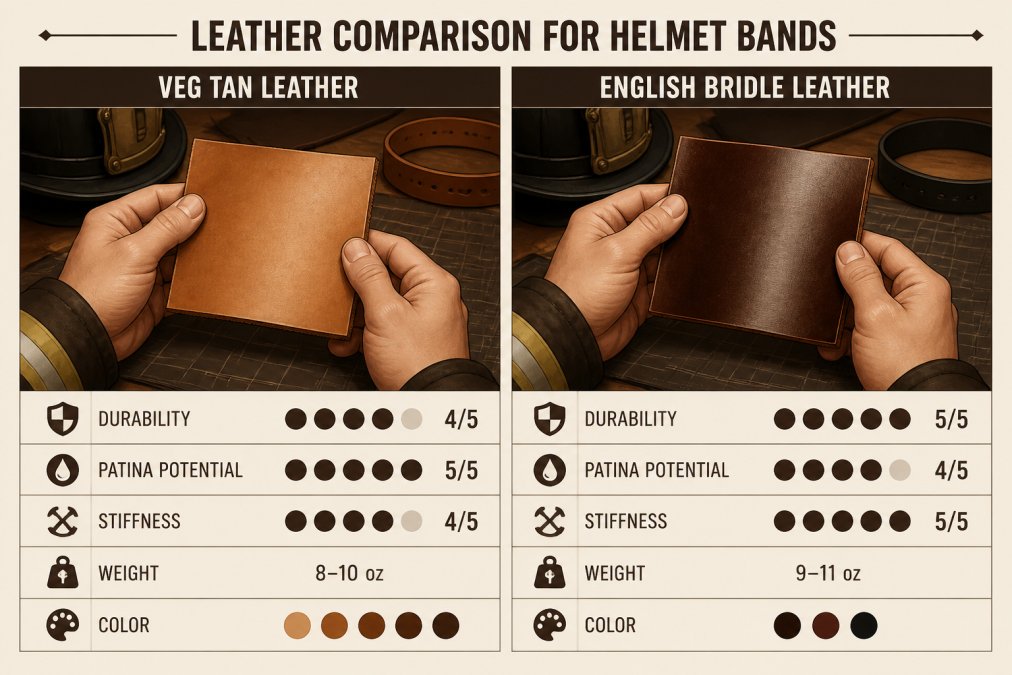
Veg Tan vs. English Bridle Leather
Veg tan leather starts lighter in color and darkens naturally over years of exposure to sunlight and sweat. It's paintable if your department allows custom designs. The downside: it absorbs moisture. If you leave it wet, it can mildew or crack as it dries unevenly.
English bridle leather doesn't darken the same way. The wax finish keeps it looking consistent. It sheds water instead of absorbing it. The trade-off is that you can't paint bridle leather, the wax coating won't hold paint well. If your department requires a specific color, veg tan gives you more flexibility.
For most structural firefighters, veg tan works fine. The helmet band isn't exposed to standing water. For wildland crews or departments that operate in heavy rain, bridle leather's moisture resistance pays off.
Evaluating Leather Weight in Ounces
A 4-ounce leather band feels substantial without being stiff. It flexes when you put the helmet on but snaps back into shape. This weight range balances durability with comfort.
At 5 to 6 ounces, the band becomes nearly rigid. Setup takes longer because you're breaking in thicker material. But this weight lasts longer under heavy use. Career firefighters who've worn the same helmet for 15+ years often prefer heavier leather.
Below 3 ounces, the band feels thin. It bends too easily and creases under pressure. These lightweight options save money upfront but typically need replacement within 3 to 5 years.
When you're evaluating a custom leather helmet band, ask the maker what weight they use. That transparency matters when you're investing in gear that'll outlast your career.
How to Measure Fire Helmet for Band Sizing
Getting the size right is non-negotiable. A band that's too loose spins on your helmet. One that's too tight cuts off circulation and becomes painful after a few hours.
You need two measurements: your helmet's circumference and the attachment point spacing.
Measuring Your Helmet Circumference
Use a soft measuring tape, the kind tailors use, not a rigid ruler. Wrap it around your helmet at the widest point, just above the brim all the way around. This is your circumference. Write it down in inches.
Most fire helmets fall between 20 and 23 inches. Structural helmets tend toward the larger end. Wildland helmets vary more because they come in fewer standard sizes.
Measure twice. Measure with the helmet on a flat surface and again while wearing it. The difference tells you how much your head compresses the band. That matters for fit.
If your measurement falls between sizes, say 21.5 inches, round up. A slightly loose band adjusts easier than one that's too tight.
Accounting for Attachment Methods
Your attachment method changes how you measure. If you're using elastic cord, the band needs to stretch slightly. If you're using fixed hardware, it needs to fit snugly without stretch.
Elastic cord bands can be 0.5 inches smaller than your exact circumference because the cord gives. Fixed hardware bands should match your measurement almost exactly.
The attachment point spacing also matters. On structural helmets, the front and back attachment points are typically 10 to 12 inches apart. Wildland helmets vary. Measure from the front attachment point (where the chin strap connects) around to the back. That distance tells the maker how to position your hardware.
Getting it right the first time saves you from ordering again.
Customization Options: Text, Initials, and Unit Numbers
Custom stamping turns a functional band into something personal. Most bands can handle text, initials, or unit numbers.
Text stamping works best for initials or short phrases, three to five characters. Longer text gets cramped. The stamping depth affects longevity. Deeper stamps last longer but are harder to read if the leather darkens.
Flashover Lids TL2 Conversion Kit →
Unit numbers are the most common customization. A four-digit number stamped on the front makes your helmet instantly identifiable in a station full of similar gear. Some departments require it for accountability.
Initials work on the side or back of the band. Placement matters. Initials on the front compete with your unit number. Side placement keeps them visible without cluttering the main band.
The stamping font matters too. Block letters are clearest and most durable. Script fonts look elegant but fill in as the leather ages and darkens. Ask your maker which fonts they recommend for long-term readability.
Selecting Color, Thread, and Reflective Features
Color choice affects both function and longevity. Black leather hides dirt and stains. Brown or tan leather shows wear more obviously but looks professional and ages well.
Thread color should contrast with the leather. Black thread on black leather disappears. Tan or white thread on black leather stands out and looks intentional. The stitching on a hand-stitched band is part of the design, choose thread color that complements your leather.
Leather and Thread Color Selection
Most structural firefighters choose black leather with tan or white thread. It's professional, hides station grime, and the contrast makes the stitching visible, which signals quality craftsmanship.
Tan leather with dark thread is popular among wildland crews. It fits the terrain aesthetic and shows less dust.
Custom colors are available from some makers, but they cost more. If your department allows it, custom colors make your band unique. If your department issues standard helmets with color requirements, stick to black or brown.
Adding Reflective Inlay and Glow-in-the-Dark Options
Reflective inlay runs along the edges of the band. It catches light at night and makes your helmet visible in low-light rescues. Most inlay is thin, 1/8 inch wide, so it doesn't interfere with fit or comfort.
Glow-in-the-dark material absorbs light during the day and glows for 4 to 6 hours after dark. It's useful for night operations. The glow fades over time, but good glow-in-the-dark material lasts 3 to 5 years before needing replacement.
Reflective and glow-in-the-dark options add to the cost, but they improve safety during low-light operations.
Attachment Methods: Elastic Cord vs. Fixed Hardware
Your attachment method determines how the band stays on your helmet and how easy it is to adjust.
Maintaining Leather Fire Gear for Long-Term Durability
A leather helmet band can outlast your career if you maintain it. Proper care costs almost nothing but saves hundreds in replacements.
Regular Cleaning and Conditioning
Wipe your band monthly with a damp cloth. Station grime, sweat, and dust accumulate. A quick wipe prevents buildup that hardens the leather.
Heat Resistance and Moisture Barriers
Leather absorbs heat. In a structure fire, the band transfers some heat to your head. Thicker leather (5 to 6 ounces) provides better insulation than thin leather.
| Maintenance Task | Frequency | Time Required |
|---|---|---|
| Wipe clean | Monthly | 2 minutes |
| Condition with oil | Every 6 months | 5 minutes |
| Air dry after getting wet | As needed | 24 hours |
| Replace elastic cord | Every 3-5 years | Professional replacement |
| Inspect for cracking | Quarterly | 1 minute |
Ensuring Compatibility with Your Helmet Type
Not all bands fit all helmets. Your helmet model determines what will work.
Structural vs. Wildland Helmet Compatibility
Structural helmets (MSA, Cairns, Morning Pride) have attachment points designed for bands. The front point sits where the chin strap connects. The back point is centered on the back.
Fitting MSA, Cairns, and Morning Pride Models
MSA helmets are the most common in structural firefighting. Most bands fit MSA helmets without issues. The attachment points are standardized.
Safety Standards and NFPA Compliance for Custom Bands
Fire service gear operates under strict safety standards. Your custom band should comply with relevant standards.
Frequently Asked Questions
What thickness of leather is best for custom leather helmet bands?
Leather weight is an important factor for firefighter helmet bands, balancing durability for daily wear on the fire ground with flexibility for a comfortable fit.
How do you measure a fire helmet for a custom leather band?
Measure the circumference of your helmet at the widest point where the band will sit, typically around the crown. Use a soft measuring tape, not a rigid ruler, and note the measurement in inches. If your helmet is older or non-standard, verify compatibility with the manufacturer before ordering.
How do you maintain and condition leather helmet gear to extend its lifespan?
Clean your leather band monthly with a damp cloth and mild soap to remove dirt and soot buildup. Apply a quality leather conditioner every 3-6 months to prevent cracking from heat exposure. Store your helmet in a cool, dry location away from direct sunlight. Proper conditioning extends the life of your gear throughout your entire career and maintains its professional appearance on the job.
Are custom leather helmet bands NFPA compliant?
Custom leather bands themselves are not independently NFPA certified products. However, high-quality leather bands designed for structural and wildland helmets can complement your existing NFPA-certified helmet without affecting its safety rating if properly installed. Always verify with your department's safety officer before adding any accessories. EH Coverings designs bands for compatibility with industry-standard helmets.